
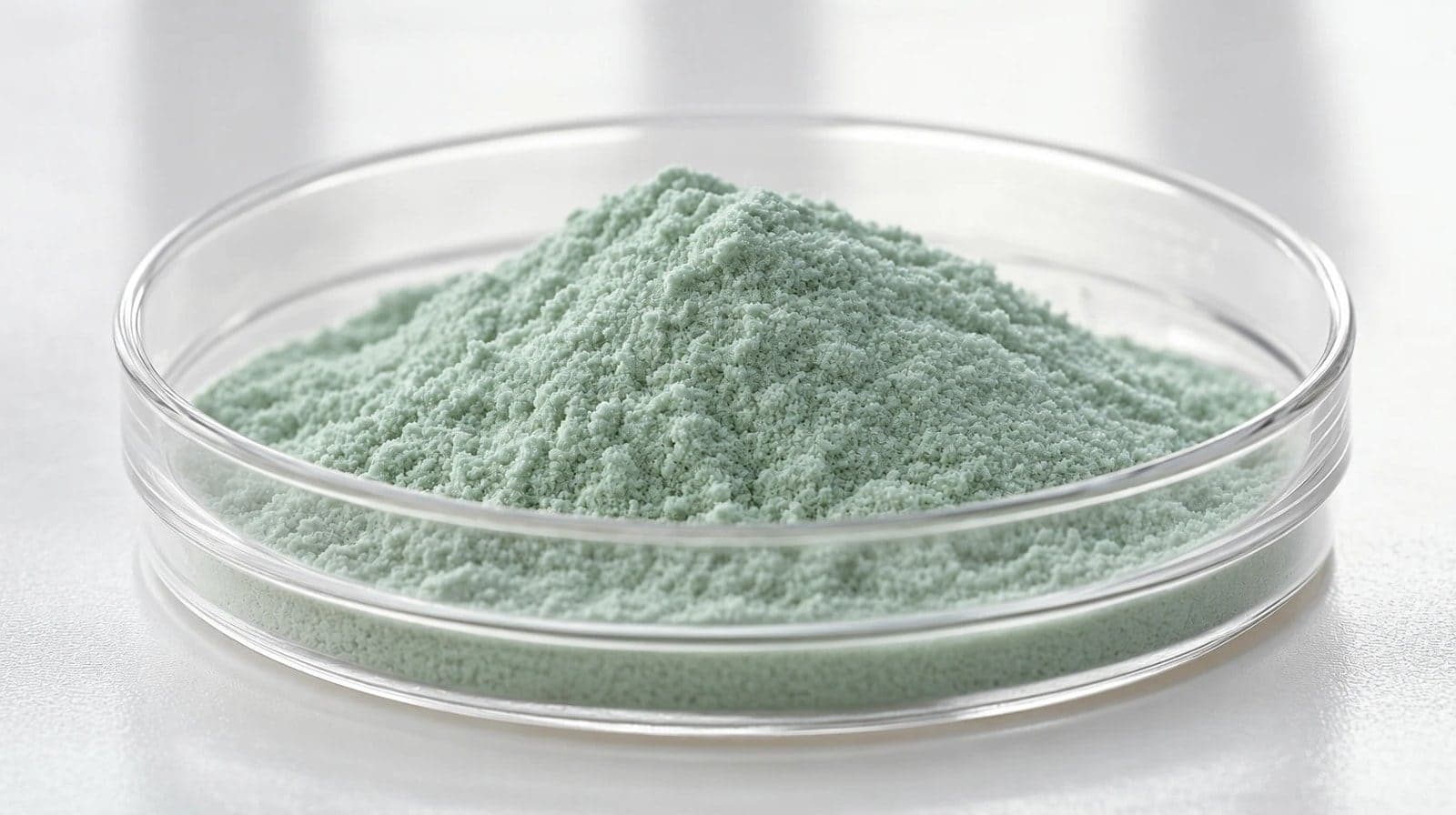
TCBS Agar
Also known as:TCBS · Thiosulfate-Citrate-Bile-Sucrose Agar · Thiosulphate Citrate Bile Salts Sucrose Agar · Vibrio Selective Agar
For the selective isolation and cultivation of Vibrio cholerae and other enteropathogenic vibrios from clinical and non-clinical specimens.
- Category
- Dehydrated Culture Media
- Dissolve per litre
- 85.45 g
- Pack sizes
- 500 g · 5 kg · 25 kg
- Certifications
- Halal
- Standard methods
- ISO 21872-1·FDA BAM
Data updated:2026-11-06
Brand cross-reference:BD Difco TCBS Agar · Oxoid TCBS Cholera Medium · Merck TCBS Agar(ISO 21872-1、FDA BAM) Brand cross-reference
Overview
TCBS Agar is an agar (solid) medium, a selective medium for food and clinical testing that suppresses competing flora and makes target colonies recognisable. Thiosulfate, citrate and bile salts suppress competitors; used to isolate Vibrio species. STBIO manufactures it from food-grade raw materials in an ISO 22000 certified facility, with a COA for every batch. This is the Halal-certified version.
Principle
TCBS Agar is a highly selective medium for the isolation of Vibrio cholerae and Vibrio parahaemolyticus, prepared according to the formula of Kobayashi et al., a modification of the medium of Nakanishi.¹ Peptone, proteose peptone, and yeast extract provide the nitrogen, vitamins, and growth factors required for organism growth. The strong alkalinity of the medium, together with the high concentrations of sodium thiosulphate and sodium citrate, largely inhibits the Enterobacteriaceae, while ox bile and sodium cholate suppress enterococci and gram-positive organisms.² Sodium chloride maintains osmotic balance and supports the growth of halophilic vibrios. Sucrose is the fermentable carbohydrate; organisms that ferment sucrose lower the pH and change the bromothymol blue and thymol blue indicators, producing yellow colonies (e.g., Vibrio cholerae), whereas non-sucrose-fermenting organisms such as Vibrio parahaemolyticus form blue-green colonies.² Sodium thiosulphate acts as a sulphur source and, with ferric citrate, detects hydrogen-sulphide production.
How selective media fit into the testing workflow
Pathogen testing normally runs in three stages: a pre-enrichment medium such as Buffered Peptone Water repairs injured cells and raises numbers, a selective enrichment then suppresses competing flora, and finally a selective differential agar isolates the target colonies. Selective agents are typically bile salts, dyes, or antibiotics; differential agents make target colonies develop a characteristic colour or morphology. Choose the combination specified by the method you follow.
Directions
Suspend 85.5 g of powder in 1 L of purified water. Heat with continuous stirring and bring to the boil for 1 minute to dissolve completely. DO NOT AUTOCLAVE. Cool to 45-50°C. Mix well and pour into sterile Petri plates.
Cultural response
| Test organism | ATCC | Growth |
|---|---|---|
| Vibrio cholerae | 9459 | good-luxuriant |
| Vibrio parahaemolyticus | 17802 | good-luxuriant |
| Escherichia coli | 25922 | inhibited-partial |
| Enterococcus faecalis | 29212 | inhibited |
Product highlights
- Halal certified, suitable for the Malaysian, Indonesian, and Middle Eastern markets
- Manufactured to the standard formulation, 85.45 g per litre
- Performance verified against standard control strains before release (Vibrio cholerae, Vibrio parahaemolyticus, Escherichia coli, Enterococcus faecalis)
- Available in 500 g / 5 kg / 25 kg, from laboratory to industrial scale
- COA, specification sheet, and technical data sheet available; samples on request
- Manufactured in Taiwan with reliable supply
FDA BAM methods
This product corresponds to a medium used in the chapters of the US FDA Bacteriological Analytical Manual (BAM), the reference methods for FDA regulatory testing. Follow the current online edition of each chapter.
- FDA BAM Chapter 9: VibrioBAM Chapter 9Isolation plateNamed in the method as:Thiosulfate-citrate-bile salts-sucrose (TCBS) agar
BAM specifies methods and media formulations; it does not certify brands. Add supplements as the chapter requires, and verify media against reference strains under your quality system.
Frequently asked questions
01Does this medium meet FDA BAM methods?
BAM specifies methods and formulations, not brands. This product corresponds to a medium used in: FDA BAM Chapter 9: Vibrio(BAM Chapter 9): Isolation plate. It is manufactured to the standard formulation and ships with a COA per batch; add supplements as the chapter requires and follow the current online edition.
02Can selective media be autoclaved?
Not always. Some media containing dyes or selective inhibitors lose their selectivity if overheated and should only be heated until fully dissolved, without autoclaving. Follow the preparation instructions for this product, and contact us if you are unsure.
03How much powder per litre?
Use 85.45 g per litre of deionised water; preparation and sterilisation conditions are given on the specification sheet.
04Which organisms is it suitable for?
Vibrio cholerae, Vibrio parahaemolyticus, Escherichia coli, Enterococcus faecalis. See the cultural response table and the specification sheet.
05What are the equivalent brand products and standard methods?
Cross-reference: BD Difco TCBS Agar, Oxoid TCBS Cholera Medium, Merck TCBS Agar. Standard methods: ISO 21872-1, FDA BAM. Formulations may differ slightly between makers; refer to the specification sheet.
06How is this product prepared?
Suspend 85.5 g of powder in 1 L of purified water. Heat with continuous stirring and bring to the boil for 1 minute to dissolve completely. DO NOT AUTOCLAVE. Cool to 45-50°C. Mix well and pour into sterile Petri plates.
07How do I request a bulk quotation, and can you provide a COA?
Yes. This product is available in 500 g, 5 kg, 25 kg. Tell us your application and volume when requesting a quotation; we reply within one working day and can supply the COA, specification sheet, and technical data sheet.
Used in these applications
Further reading
- FDA BAM Culture Media Cross-Reference: Which Media Each BAM Chapter Uses and the STBIO EquivalentAerobic plate count, coliforms and E. coli, Salmonella, Listeria monocytogenes, Staphylococcus aureus, Bacillus cereus, Vibrio, Clostridium perfringens, yeasts and moulds and Cronobacter: the media named in each FDA Bacteriological Analytical Manual chapter, matched to Taiwan-made dehydrated media for US laboratories qualifying a second source.
- Which Culture Media Do Taiwan FDA Food Microbiology Methods Specify? Cross-Reference for 21 Announced MethodsAerobic plate count, coliforms, E. coli, Enterobacteriaceae, Salmonella, Staphylococcus aureus, Listeria monocytogenes, lactic acid bacteria, yeasts and moulds, Bacillus cereus, Vibrio parahaemolyticus, Clostridium perfringens and Cronobacter: the media named in each Taiwan FDA (TFDA) announced method, matched to Taiwan-made products.
References
- 1. Kobayashi T., Enomoto S., Sakazaki R. and Kuwahara S., 1963. A new selective isolation medium for pathogenic vibrios: TCBS agar. Jpn. J. Bacteriol., 18:387-391.
- 2. Atlas R. M., 2010. Handbook of Microbiological Media, 4th Ed., CRC Press, Boca Raton.