
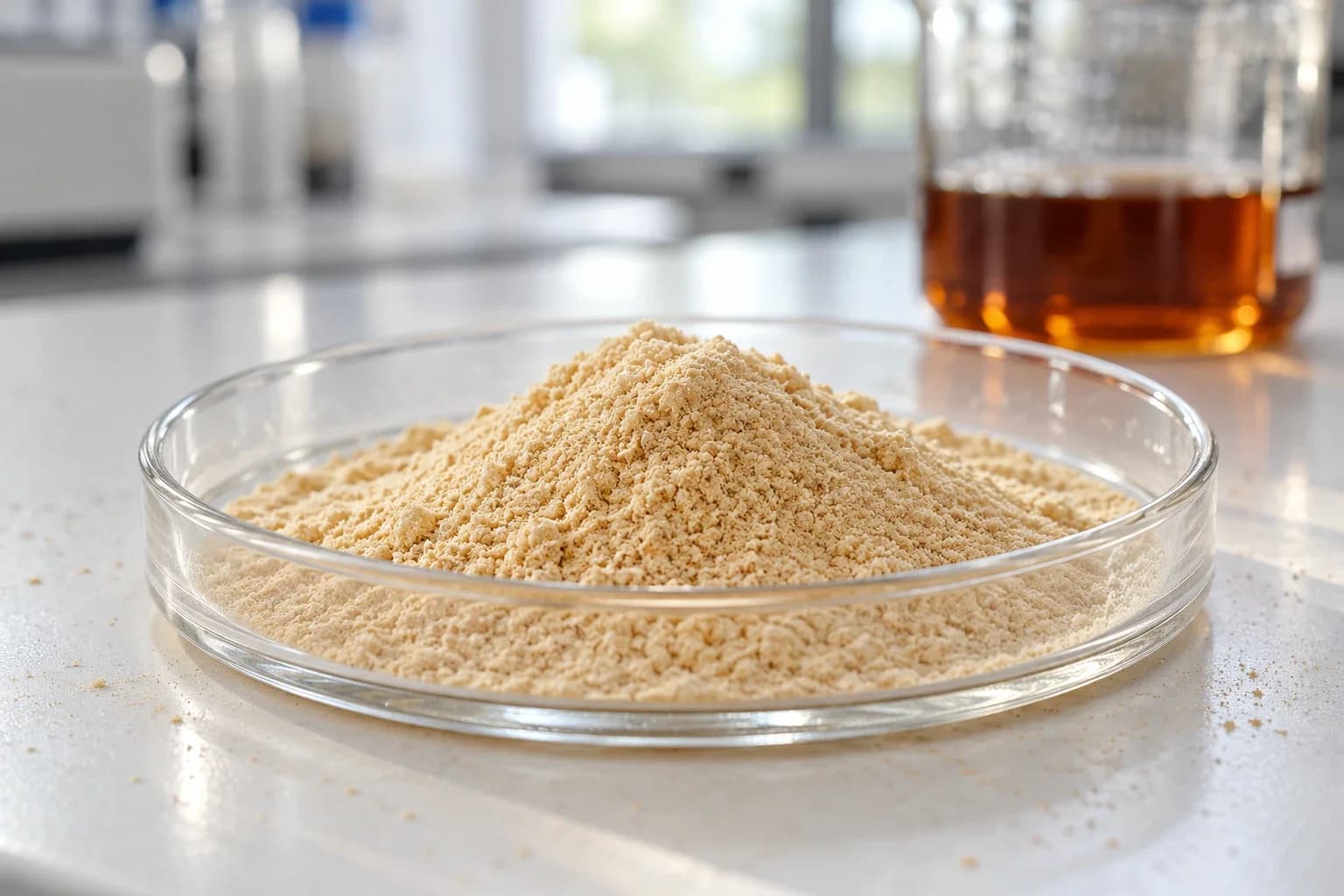
Yeast Peptone Z105
Used as a nutrient source in a wide range of fermentation processes, including lactic acid cultures, pharmaceutical production, and bioremediation, and is also suitable for the cultivation of Escherichia coli and recombinant protein production.
- Category
- Peptones & Protein Hydrolysates
- pH (25 °C)
- 5.0 – 6.5
- Appearance
- Yellow to brown powder
- Pack sizes
- 500 g · 5 kg · 25 kg
- Raw material
- Yeast
- Certifications
- ISO 22000 · Halal · Non-GMO · Animal-free · Allergen-free
Data updated:2026-11-06
Overview
A fine yellow to brown powder derived from primary-grown Saccharomyces cerevisiae, cultivated specifically for this purpose and processed under controlled conditions to preserve its full nutritional value. Rich in B-complex vitamins and with a low salt content, it provides readily assimilable peptides, free amino acids, minerals, and other growth factors. Animal-free; raw materials are of microbial (yeast) origin.
Yeast peptone, yeast extract or yeast peptide: how to choose
All three come from yeast and are animal-free; they differ in molecular size and composition. Yeast extract is the water-soluble fraction after autolysis, highest in free amino acids, B vitamins and nucleotides, and is used to supply growth factors. Yeast peptone is mainly short and medium peptides with a steadier nitrogen release, suited to fermentations that need nitrogen over a long run. Yeast peptides are smaller still and taken up quickly. Fastidious organisms such as lactic acid bacteria and bifidobacteria usually get both: peptone for nitrogen, extract for growth factors. Grades within a range differ in total nitrogen, amino nitrogen ratio, nucleotides and clarity in solution; see the specification sheets.
Specifications
| Parameter | Specification |
|---|---|
| Appearance | Yellow to brown powder |
| Total nitrogen TN | ≥ 9.8 % |
| pH (2 % solution) | 5.0 – 6.5 |
| Loss on drying | ≤ 8.0 % |
| Chlorides (as NaCl) | ≤ 1.0 % |
| Total aerobic microbial count | ≤ 10,000/g |
| Staphylococcus aureus | absence/10g |
| Salmonella | absence/25g |
| Escherichia coli | absence/g |
| Coliforms | ≤ 10/g |
| Yeasts and moulds | ≤ 100/g |
Release specifications. Actual values are reported on the COA supplied with each batch.
Product highlights
- Food-grade raw materials, produced in an ISO 22000 certified facility
- Halal certified, suitable for the Malaysian, Indonesian, and Middle Eastern markets
- Clear solution, B-vitamin rich, Non-GMO, Animal-origin-free (AOF)
- Available in 500 g / 5 kg / 25 kg, from laboratory to industrial scale
- COA, specification sheet, and technical data sheet available; samples on request
- Manufactured in Taiwan with reliable supply
Food grade versus laboratory grade
Most culture media suppliers use laboratory-grade raw materials, which are held to lower standards for heavy metal residues, microbial contamination control, and traceability. That is adequate for pure research but not for applications with stricter raw-material requirements. STBIO manufactures with food-grade raw materials throughout, in a facility certified to ISO 22000 food safety management.
- Food microbiology laboratories working to ISO 17025 or equivalent requirements
- Biotech manufacturers exporting fermentation products and needing full raw-material traceability
- Organisations with ESG or compliance audit requirements across their supply chain
- Companies sourcing both Halal and non-Halal products who need one consistent material grade
Frequently asked questions
01Can yeast peptone replace beef or soy peptone?
In most fermentations it can replace them partly or fully, with the advantage of containing no animal components and no soy allergen, which suits Halal, vegetarian and animal-free formulations. Strains differ in their nitrogen preference, so trial 25%, 50% and 100% replacement and compare growth curves and product.
02How much yeast peptone should be added when a fermentation underperforms?
Start at 1 to 5 g per litre and adjust to the total nitrogen of the existing formulation. Yeast peptone is naturally rich in amino acids, B vitamins and nucleotides, so a small addition often fixes a slow start or a low cell count; too much can cause foaming and raise cost.
03Which organisms is it suitable for?
Coliforms, E. coli. See the cultural response table and the specification sheet.
04Is it free of animal-derived components?
Yes. This product is animal-origin-free, suitable for animal-free formulations and Halal requirements; a declaration is available on request.
05Is the raw material non-GMO?
Yes. The raw material is non-GMO; the supplier declaration can be provided with the COA.
06Can it be used for food-grade applications?
Yes. It is made from food-grade raw materials in an ISO 22000 certified facility and is suitable for culturing starters for fermented products that are consumed directly.
07How do I request a bulk quotation, and can you provide a COA?
Yes. This product is available in 500 g, 5 kg, 25 kg. Tell us your application and volume when requesting a quotation; we reply within one working day and can supply the COA, specification sheet, and technical data sheet.
Academic citation
Products from this range have been cited as the culture media source in a peer-reviewed study by a National Taiwan University research team:
Chan et al. (2024). Single-strain probiotics enhance growth, anti-pathogen immunity, and resistance to Nocardia seriolae in grey mullet (Mugil cephalus) via gut microbiota modulation. Animal Microbiome, 6, 67. Springer Nature.
Media attribution: Tryptone Soy Broth, MRS medium, LB broth, beef extract, peptone, yeast extract, agar (STBIO, New Taipei, Taiwan)
Read the full paperUsed in these applications
- Fast-Growth & High-Efficiency Fermentation Nutrient SeriesRich in low-molecular-weight peptides, free amino acids, nucleotides and B vitamins to bring microorganisms into growth quickly, shortening fermentation time and raising line productivity.
- Targeted Nutrient Booster SeriesTargeted supplements of amino acids, B vitamins, nucleotides and trace minerals matched to the organism and fermentation stage, resolving nutrient limitation, slow growth and poor yield.
- High Spore Yield Nutrient SeriesNutrient formulations designed for the growth and sporulation of spore-forming bacteria, improving spore yield, sporulation rate and product quality. For Bacillus subtilis, B. amyloliquefaciens, B. velezensis and other biopesticide and biofertilizer strains.