
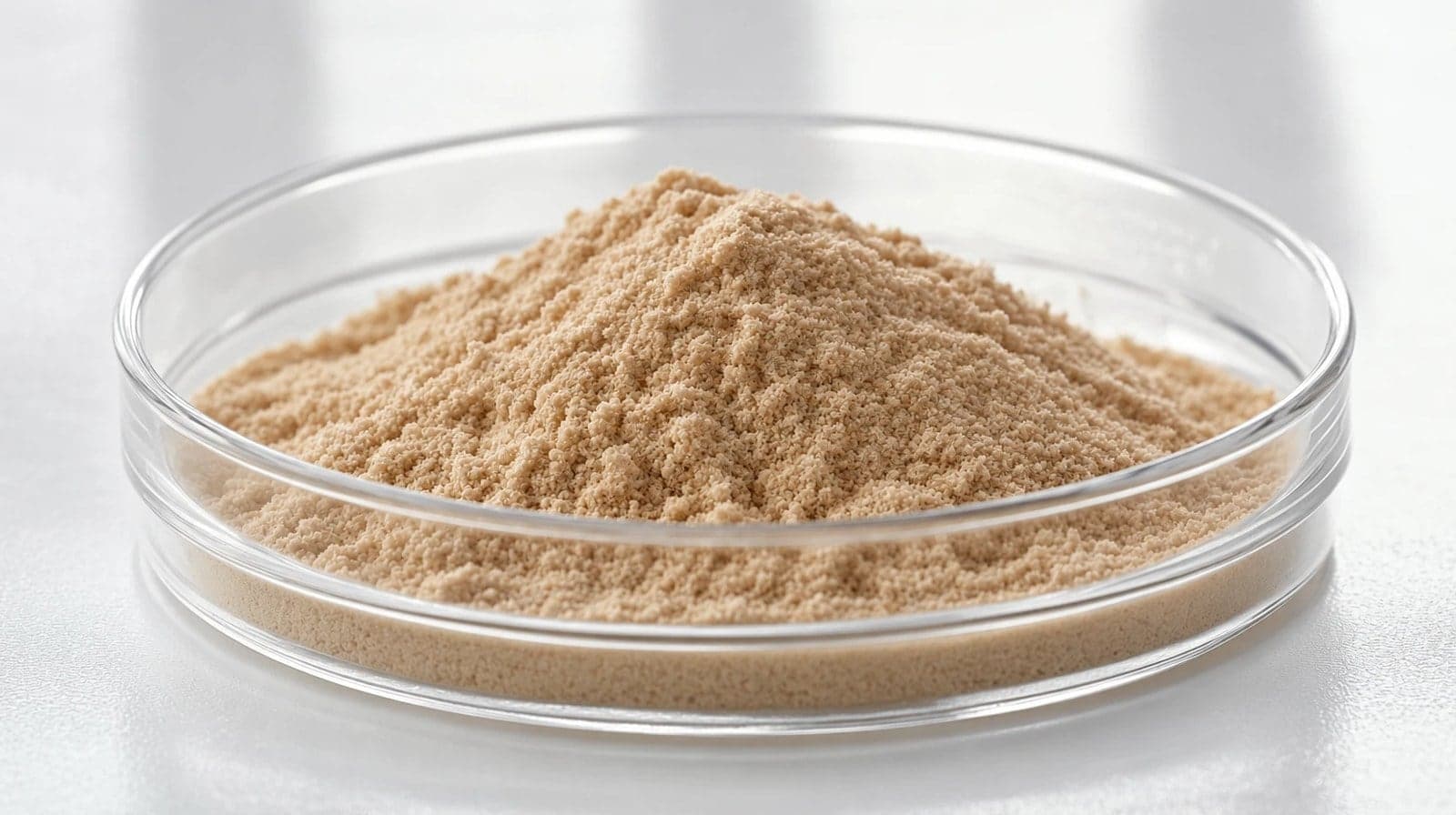
Lactobacilli MRS Agar Food Grade
Also known as:MRS Agar
Lactobacilli MRS Agar Food Grade is used for the cultivation of lactic acid bacteria such as Lactobacillus, Streptococcus, Pediococcus and Leuconostoc.
- Category
- Dehydrated Culture Media
- Dissolve per litre
- 70.15 g
- pH (25 °C)
- 6.0 ± 0.5
- Appearance
- Beige powder
- Pack sizes
- 500 g · 5 kg · 25 kg
- Certifications
- ISO 22000 · Halal · Animal-free
Data updated:2026-11-06
- Storage
- Store at 2–8 °C in sealed, dry, clean conditions.
- Shelf life
- 36 months from manufacture date when stored as directed.
Overview
Lactobacilli MRS Agar Food Grade is the food-grade solid form of the standard MRS formulation (de Man, Rogosa and Sharpe, 1960) for isolating, counting and picking single colonies of lactobacilli, streptococci, pediococci and leuconostocs, and the usual plate medium for lactic acid bacteria counts in food. Soy and casein peptones replace meat peptone, so it contains no meat; polysorbate 80 supplies the fatty acids lactic acid bacteria need, and sodium acetate with citric acid suppresses competing flora. Made entirely from food-grade raw materials with Halal certification, so probiotic and fermented-food producers can use the same medium from R&D and QC through to starter preparation.
Principle
The medium is based on the formulation of de Man, Rogosa and Sharpe for the luxuriant growth of lactobacilli, with the animal tissue peptone and beef extract of the original replaced by soy and casein peptones.¹ Soy peptone, casein peptone, and yeast extract supply nitrogen, amino acids, peptides, B-group vitamins, and growth factors, and glucose serves as the fermentable carbohydrate and energy source. Polysorbate 80 provides the fatty acids required by many lactobacilli, while magnesium sulphate and the mineral supplement supply the ions essential for their metabolism. Dipotassium hydrogen phosphate buffers the medium. Sodium acetate and citrate inhibit many competing organisms, including most Gram-negative bacteria and moulds, while permitting the growth of lactic acid bacteria. The medium is suitable for the colony count of mesophilic lactic acid bacteria in food, probiotic preparations, and animal feed.²
Agar or broth: which to choose
MRS Agar is used for enumeration and single-colony isolation of lactic acid bacteria, the standard choice in fermented food and probiotic quality control. MRS Broth is used for strain activation, seed culture, and pre-fermentation scale-up. The two share the same formulation base and differ only in the solidifying agent.
Specifications
| Parameter | Specification |
|---|---|
| Appearance | Beige powder |
| pH (at 25°C) | 6.0 ± 0.5 |
Release specifications. Actual values are reported on the COA supplied with each batch.
Directions
Suspend 70.15 g of powder in 1 L of purified water. Heat with continuous stirring and bring to the boil for 1 minute. Sterilize by autoclaving at 121°C for 15 minutes. Avoid overheating. Cool to 45-50°C. Mix well and pour into sterile Petri plates. Test the finished medium for performance using stable, standard control cultures.
Cultural response
| Test organism | ATCC | Growth |
|---|---|---|
| Lactobacillus delbrueckii subsp. lactis | 7830 | Good |
| Lactobacillus fermentum | 9338 | Good |
| Lactobacillus johnsonii | 11506 | Good |
Product highlights
- Food-grade raw materials, produced in an ISO 22000 certified facility
- Halal certified, suitable for the Malaysian, Indonesian, and Middle Eastern markets
- Manufactured to the standard formulation, 70.15 g per litre, pH 6.0 ± 0.5
- Performance verified against standard control strains before release (Lactobacillus delbrueckii subsp. lactis, Lactobacillus fermentum, Lactobacillus johnsonii)
- Animal-origin-free (AOF)
- Available in 500 g / 5 kg / 25 kg, from laboratory to industrial scale
- COA, specification sheet, and technical data sheet available; samples on request
- Manufactured in Taiwan with reliable supply
Food grade versus laboratory grade
Most culture media suppliers use laboratory-grade raw materials, which are held to lower standards for heavy metal residues, microbial contamination control, and traceability. That is adequate for pure research but not for applications with stricter raw-material requirements. STBIO manufactures with food-grade raw materials throughout, in a facility certified to ISO 22000 food safety management.
- Food microbiology laboratories working to ISO 17025 or equivalent requirements
- Biotech manufacturers exporting fermentation products and needing full raw-material traceability
- Organisations with ESG or compliance audit requirements across their supply chain
- Companies sourcing both Halal and non-Halal products who need one consistent material grade
Frequently asked questions
01How does food-grade MRS differ from standard MRS?
The food-grade version is manufactured from food-grade raw materials and replaces animal-derived nitrogen sources with plant- and yeast-based alternatives. It suits fermented foods and probiotic products that require Halal certification, vegetarian labelling, or full raw-material traceability. Performance is verified against standard control strains.
02How much powder per litre?
Use 70.15 g per litre of deionised water; pH after sterilisation 6.0 ± 0.5. Preparation and sterilisation conditions are given on the specification sheet.
03Which organisms is it suitable for?
Lactobacillus delbrueckii subsp. lactis, Lactobacillus fermentum, Lactobacillus johnsonii. See the cultural response table and the specification sheet.
04Is it free of animal-derived components?
Yes. This product is animal-origin-free, suitable for animal-free formulations and Halal requirements; a declaration is available on request.
05Can it be used for food-grade applications?
Yes. It is made from food-grade raw materials in an ISO 22000 certified facility and is suitable for culturing starters for fermented products that are consumed directly.
06How is this product prepared?
Suspend 70.15 g of powder in 1 L of purified water. Heat with continuous stirring and bring to the boil for 1 minute. Sterilize by autoclaving at 121°C for 15 minutes. Avoid overheating. Cool to 45-50°C. Mix well and pour into sterile Petri plates. Test the finished medium for performance using stable, standard control cultures.
07How should it be stored, and what is the shelf life?
Store at 2–8 °C in sealed, dry, clean conditions. 36 months from manufacture date when stored as directed.
08How do I request a bulk quotation, and can you provide a COA?
Yes. This product is available in 500 g, 5 kg, 25 kg. Tell us your application and volume when requesting a quotation; we reply within one working day and can supply the COA, specification sheet, and technical data sheet.
Academic citation
Products from this range have been cited as the culture media source in a peer-reviewed study by a National Taiwan University research team:
Chan et al. (2024). Single-strain probiotics enhance growth, anti-pathogen immunity, and resistance to Nocardia seriolae in grey mullet (Mugil cephalus) via gut microbiota modulation. Animal Microbiome, 6, 67. Springer Nature.
Media attribution: Tryptone Soy Broth, MRS medium, LB broth, beef extract, peptone, yeast extract, agar (STBIO, New Taipei, Taiwan)
Read the full paperUsed in these applications
Used in published research and patents
- Particulate Cell Wall Materials of Lactobacillus acidophilus as Vaccine AdjuvantVeterinary Sciences 2022 · National Taipei University of TechnologyLactobacillus acidophilus cultured on MRS agar plates.
- Publications
Further reading
References
- 1. de Man J. C., Rogosa M. and Sharpe M. E., 1960. A medium for the cultivation of lactobacilli. J. Appl. Bacteriol., 23:130-135.
- 2. ISO 15214, Microbiology of food and animal feeding stuffs — Horizontal method for the enumeration of mesophilic lactic acid bacteria — Colony-count technique at 30°C, International Organization for Standardization, Geneva.