
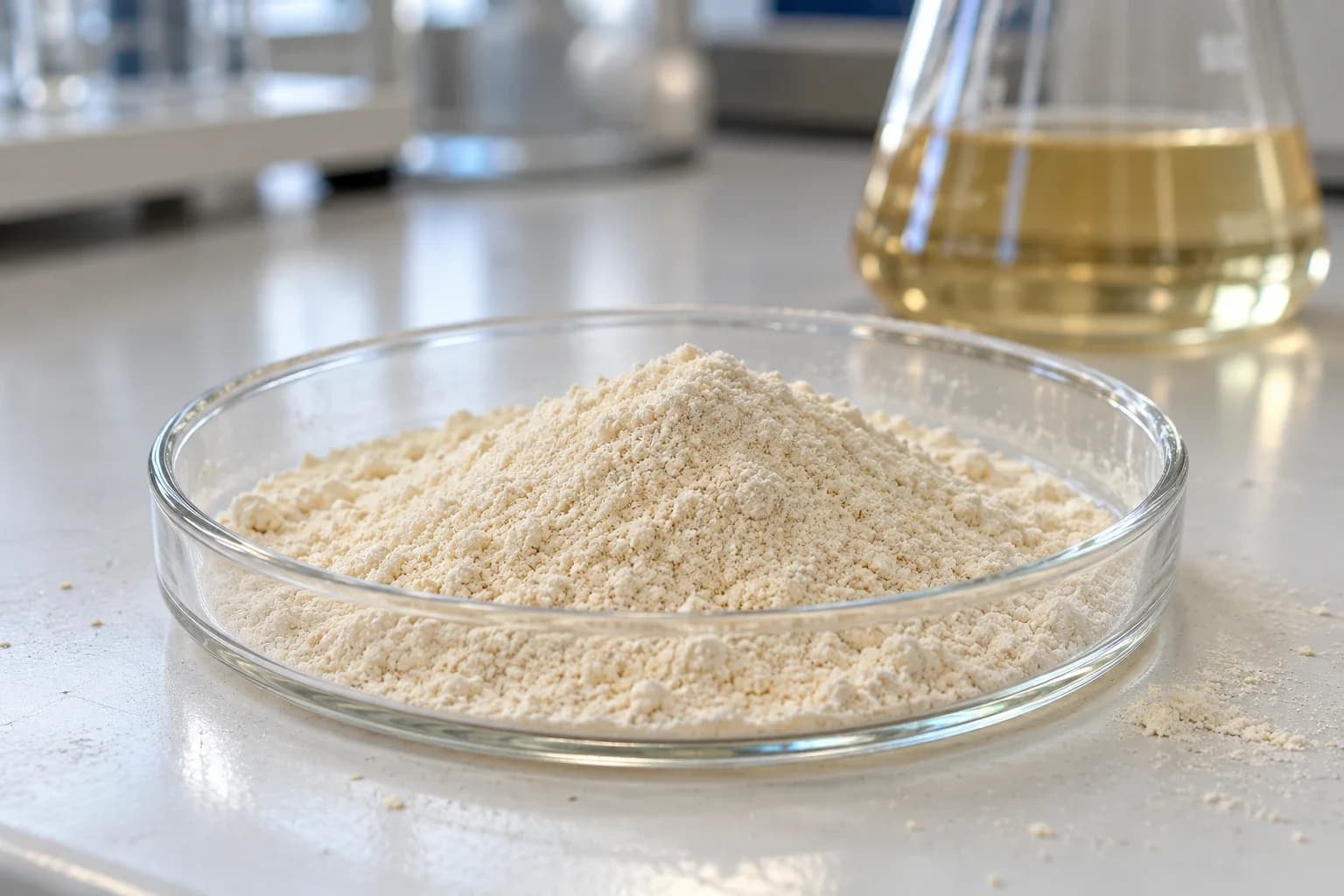
 Illustrative image only. Actual product may vary.
Maximum Recovery Diluent
Also known as:MRD · Peptone Salt Broth · Peptone Salt Solution · Peptone Saline Diluent
For the preparation of initial suspensions and decimal dilutions of food, animal feed, and environmental samples for microbiological examination.
- Category
- Dehydrated Culture Media
- Dissolve per litre
- 9.5 g
- Pack sizes
- 500 g · 5 kg · 25 kg
Data updated:2026-11-06
Overview
Maximum Recovery Diluent (MRD) is the general-purpose diluent specified by ISO 6887: an isotonic solution of 0.1% peptone and 0.85% sodium chloride that keeps counts stable during the 45 minutes of homogenisation and serial dilution, unlike plain water or saline in which injured cells die off. ISO 11133, ISO 4833 and most ISO food methods use it for sample preparation, and a laboratory handling dozens of samples a day consumes it in volume. Food-grade raw materials.
Principle
Maximum Recovery Diluent combines the protective effect of a low concentration of peptone with the osmotic support of physiological saline. Studies by Straka and Stokes showed that bacteria can be rapidly killed in commonly used diluents such as water and that the addition of a small amount of peptone largely eliminates this loss.¹ Peptone protects microbial cells against osmotic shock and starvation during sample preparation, and sodium chloride maintains an isotonic environment. The low peptone content does not support significant multiplication within the recommended holding time. The diluent is specified for the preparation of initial suspensions and decimal dilutions in the microbiological examination of food and animal feed.²
Directions
Suspend 9.5 g of powder in 1 L of purified water. Heat with continuous stirring and bring to the boil for 1 minute. Dispense into suitable containers. Sterilize by autoclaving at 121°C for 15 minutes. Test the finished medium for performance using stable, standard control cultures.
Cultural response
| Test organism | ATCC | Growth |
|---|---|---|
| Escherichia coli | 25922 | satisfactory |
| Staphylococcus aureus | 6538 | satisfactory |
Product highlights
- Manufactured to the standard formulation, 9.5 g per litre
- Performance verified against standard control strains before release (Escherichia coli, Staphylococcus aureus)
- Available in 500 g / 5 kg / 25 kg, from laboratory to industrial scale
- COA, specification sheet, and technical data sheet available; samples on request
- Manufactured in Taiwan with reliable supply
Frequently asked questions
01How much powder per litre?
Use 9.5 g per litre of deionised water; preparation and sterilisation conditions are given on the specification sheet.
02Which organisms is it suitable for?
Total Plate Count, Escherichia coli, Staphylococcus aureus. See the cultural response table and the specification sheet.
03How is this product prepared?
Suspend 9.5 g of powder in 1 L of purified water. Heat with continuous stirring and bring to the boil for 1 minute. Dispense into suitable containers. Sterilize by autoclaving at 121°C for 15 minutes. Test the finished medium for performance using stable, standard control cultures.
04How do I request a bulk quotation, and can you provide a COA?
Yes. This product is available in 500 g, 5 kg, 25 kg. Tell us your application and volume when requesting a quotation; we reply within one working day and can supply the COA, specification sheet, and technical data sheet.
References
- 1. Straka R. P. and Stokes J. L., 1957. Rapid destruction of bacteria in commonly used diluents and its elimination. Appl. Microbiol., 5:21-25.
- 2. ISO 6887-1, Microbiology of the food chain — Preparation of test samples, initial suspension and decimal dilutions for microbiological examination — Part 1: General rules for the preparation of the initial suspension and decimal dilutions, International Organization for Standardization, Geneva.