
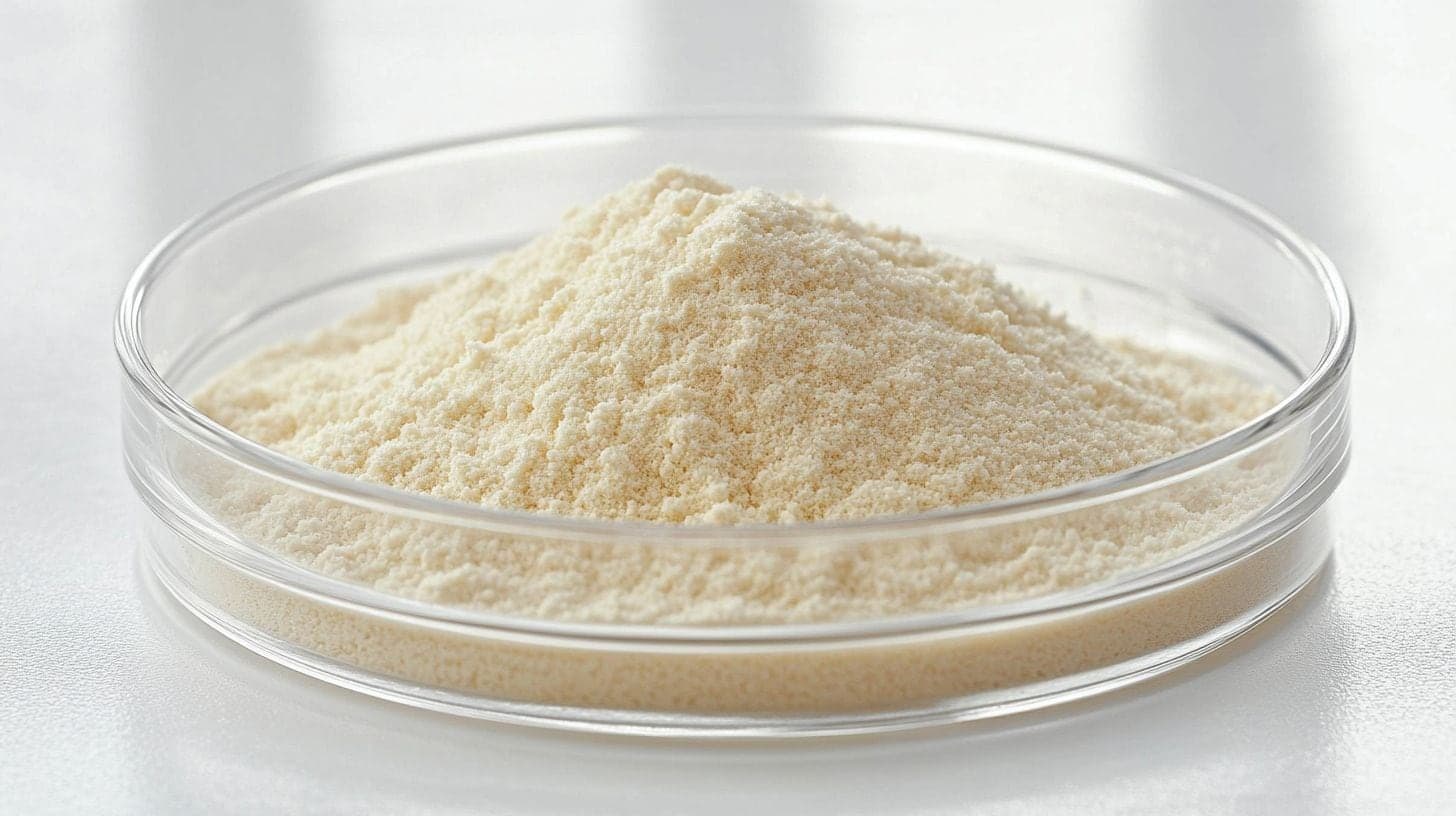
 Illustrative image only. Actual product may vary.
m-FC Agar
Also known as:m-FC · mFC Agar · M-FC Agar · Fecal Coliform Agar · m FC Agar Base · Fecal Coliforms Agar
For the detection and enumeration of fecal coliforms in water by the membrane filtration technique.
- Category
- Dehydrated Culture Media
- Dissolve per litre
- 52.1 g
- Pack sizes
- 500 g · 5 kg · 25 kg
Data updated:2026-11-06
Overview
m-FC Agar is the membrane filtration medium for faecal coliforms in water: incubation at an elevated 44.5 °C combined with rosolic acid and bile salts selects for faecal coliforms, which ferment lactose and turn the aniline blue indicator to give blue colonies. Specified by APHA Standard Methods 9222D, it is a standard item for monitoring rivers, aquaculture water, recreational waters and treated wastewater effluent. Contains dye; heat to dissolve without autoclaving.
Principle
m-FC Agar was developed by Geldreich and co-workers for the enumeration of fecal coliforms by membrane filtration without a preliminary enrichment step.¹ Tryptose, proteose peptone, and yeast extract supply nitrogen, amino acids, vitamins, and growth factors, and sodium chloride maintains the osmotic equilibrium. Lactose is the fermentable carbohydrate. Bile salts inhibit Gram-positive organisms, and rosolic acid suppresses the background growth of non-coliform bacteria. Membranes are incubated at 44.5°C, a temperature at which only thermotolerant (fecal) coliforms grow well. Fecal coliforms ferment lactose, and the acid produced reacts with aniline blue so that colonies appear in various shades of blue; non-fecal coliforms and other organisms form grey to cream-coloured colonies. Blue colonies are counted and the result is expressed as fecal coliforms per 100 mL of sample.²
Directions
Suspend 52.1 g of powder in 1 L of purified water containing 10 mL of a 1% solution of rosolic acid in 0.2 N sodium hydroxide. Heat with continuous stirring and bring to the boil for 1 minute. DO NOT AUTOCLAVE. Cool to 45-50°C and dispense into 50-60 mm Petri plates. Test the finished medium for performance using stable, standard control cultures.
Cultural response
| Test organism | ATCC | Growth |
|---|---|---|
| Escherichia coli | 25922 | good-luxuriant |
| Klebsiella aerogenes | 13048 | inhibited-partial |
| Enterococcus faecalis | 29212 | inhibited |
Product highlights
- Manufactured to the standard formulation, 52.1 g per litre
- Performance verified against standard control strains before release (Escherichia coli, Klebsiella aerogenes, Enterococcus faecalis)
- Available in 500 g / 5 kg / 25 kg, from laboratory to industrial scale
- COA, specification sheet, and technical data sheet available; samples on request
- Manufactured in Taiwan with reliable supply
Frequently asked questions
01How much powder per litre?
Use 52.1 g per litre of deionised water; preparation and sterilisation conditions are given on the specification sheet.
02Which organisms is it suitable for?
Coliforms, Gram-negative, E. coli, Escherichia coli, Klebsiella aerogenes, Enterococcus faecalis. See the cultural response table and the specification sheet.
03How is this product prepared?
Suspend 52.1 g of powder in 1 L of purified water containing 10 mL of a 1% solution of rosolic acid in 0.2 N sodium hydroxide. Heat with continuous stirring and bring to the boil for 1 minute. DO NOT AUTOCLAVE. Cool to 45-50°C and dispense into 50-60 mm Petri plates. Test the finished medium for performance using stable, standard control cultures.
04How do I request a bulk quotation, and can you provide a COA?
Yes. This product is available in 500 g, 5 kg, 25 kg. Tell us your application and volume when requesting a quotation; we reply within one working day and can supply the COA, specification sheet, and technical data sheet.
References
- 1. Geldreich E. E., Clark H. F., Huff C. B. and Best L. C., 1965. Fecal-coliform-organism medium for the membrane filter technique. J. Am. Water Works Assoc., 57:208-214.
- 2. American Public Health Association, Standard Methods for the Examination of Water and Wastewater, current edition, APHA Press, Washington, D.C.