
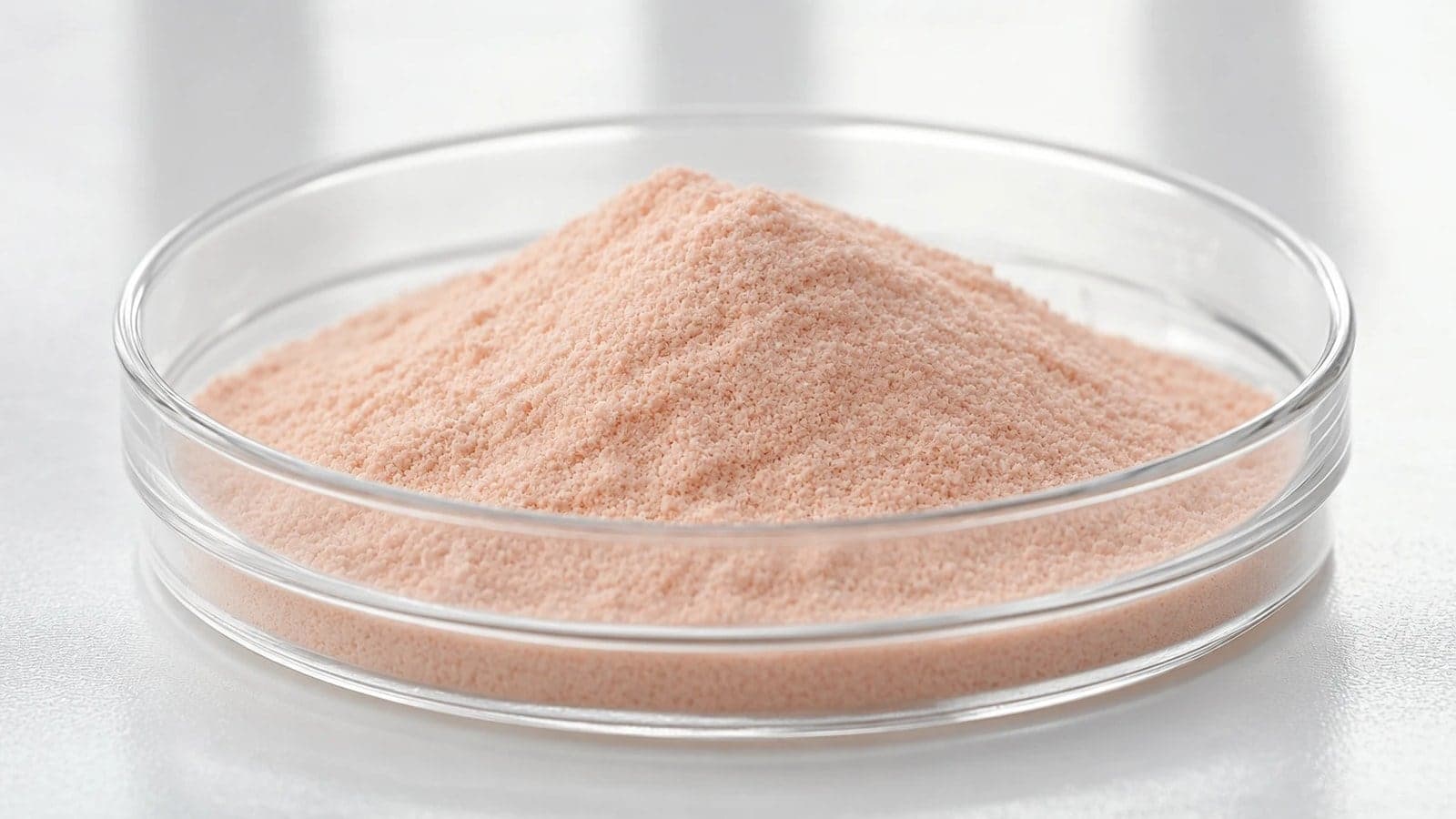
 Illustrative image only. Actual product may vary.
PALCAM Agar Base
Also known as:PALCAM · PALCAM Listeria Selective Agar Base · PALCAM Medium · Polymyxin Acriflavine Lithium Chloride Ceftazidime Aesculin Mannitol Agar
For the selective isolation and differentiation of Listeria species from food and environmental samples, following the addition of PALCAM Selective Supplement.
- Category
- Dehydrated Culture Media
- Dissolve per litre
- 68.88 g
- Pack sizes
- 500 g · 5 kg · 25 kg
Data updated:2026-11-06
Overview
PALCAM Agar Base is a selective differential isolation plate for Listeria: lithium chloride and the antibiotic supplement added before use (polymyxin B, acriflavine, ceftazidime) suppress competing flora; aesculin, salicin and ferric ammonium citrate give Listeria grey-green colonies with a black halo, while mannitol and phenol red turn mannitol-fermenting enterococci and staphylococci yellow for differentiation. The Taiwan FDA Listeria monocytogenes method lists it alongside Oxford and modified Oxford agar as an isolation plate, and ISO 11290 names it as the second plate. A base formulation; add the supplement per the method.
Principle
PALCAM Agar was developed by van Netten and co-workers for the selective isolation and differentiation of Listeria species from foods.¹ Peptone and yeast extract supply nitrogen, amino acids, vitamins, and growth factors, glucose provides an energy source, and starch absorbs toxic metabolites. Sodium chloride maintains the osmotic equilibrium. Selectivity is provided by lithium chloride in the base, together with polymyxin B, which inhibits Gram-negative bacteria, and acriflavine and ceftazidime, which suppress Gram-positive and other competing organisms. Two indicator systems allow differentiation. Listeria species hydrolyse esculin to esculetin, which reacts with ferric ions to form a black complex around the colonies. Listeria species do not ferment mannitol, whereas contaminants such as enterococci and staphylococci that do so lower the pH and turn the phenol red indicator yellow. Typical Listeria colonies are grey-green, 1.5-2 mm in diameter, with a sunken black centre and a surrounding black halo.²
Directions
Suspend 68.88 g of powder in 1 L of purified water. Heat with continuous stirring and bring to the boil for 1 minute. Sterilize by autoclaving at 121°C for 15 minutes. Cool to 45-50°C and aseptically add PALCAM Selective Supplement to give final concentrations of 10 mg/L polymyxin B sulphate, 5 mg/L acriflavine hydrochloride, and 20 mg/L ceftazidime. Mix well and pour into sterile Petri plates. Test the finished medium for performance using stable, standard control cultures.
Product highlights
- Manufactured to the standard formulation, 68.88 g per litre
- Available in 500 g / 5 kg / 25 kg, from laboratory to industrial scale
- COA, specification sheet, and technical data sheet available; samples on request
- Manufactured in Taiwan with reliable supply
FDA BAM methods
This product corresponds to a medium used in the chapters of the US FDA Bacteriological Analytical Manual (BAM), the reference methods for FDA regulatory testing. Follow the current online edition of each chapter.
- FDA BAM Chapter 10: Listeria monocytogenesBAM Chapter 10Isolation plateNamed in the method as:PALCAM agar base
BAM specifies methods and media formulations; it does not certify brands. Add supplements as the chapter requires, and verify media against reference strains under your quality system.
Frequently asked questions
01Does this medium meet FDA BAM methods?
BAM specifies methods and formulations, not brands. This product corresponds to a medium used in: FDA BAM Chapter 10: Listeria monocytogenes(BAM Chapter 10): Isolation plate. It is manufactured to the standard formulation and ships with a COA per batch; add supplements as the chapter requires and follow the current online edition.
02How much powder per litre?
Use 68.88 g per litre of deionised water; preparation and sterilisation conditions are given on the specification sheet.
03Which organisms is it suitable for?
Pathogens, Gram-positive, Listeria. See the cultural response table and the specification sheet.
04How is this product prepared?
Suspend 68.88 g of powder in 1 L of purified water. Heat with continuous stirring and bring to the boil for 1 minute. Sterilize by autoclaving at 121°C for 15 minutes. Cool to 45-50°C and aseptically add PALCAM Selective Supplement to give final concentrations of 10 mg/L polymyxin B sulphate, 5 mg/L acriflavine hydrochloride, and 20 mg/L ceftazidime. Mix well and pour into sterile Petri plates. Test the finished medium for performance using stable, standard control cultures.
05How do I request a bulk quotation, and can you provide a COA?
Yes. This product is available in 500 g, 5 kg, 25 kg. Tell us your application and volume when requesting a quotation; we reply within one working day and can supply the COA, specification sheet, and technical data sheet.
Further reading
- FDA BAM Culture Media Cross-Reference: Which Media Each BAM Chapter Uses and the STBIO EquivalentAerobic plate count, coliforms and E. coli, Salmonella, Listeria monocytogenes, Staphylococcus aureus, Bacillus cereus, Vibrio, Clostridium perfringens, yeasts and moulds and Cronobacter: the media named in each FDA Bacteriological Analytical Manual chapter, matched to Taiwan-made dehydrated media for US laboratories qualifying a second source.
- Which Culture Media Do Taiwan FDA Food Microbiology Methods Specify? Cross-Reference for 21 Announced MethodsAerobic plate count, coliforms, E. coli, Enterobacteriaceae, Salmonella, Staphylococcus aureus, Listeria monocytogenes, lactic acid bacteria, yeasts and moulds, Bacillus cereus, Vibrio parahaemolyticus, Clostridium perfringens and Cronobacter: the media named in each Taiwan FDA (TFDA) announced method, matched to Taiwan-made products.
References
- 1. van Netten P., Perales I., van de Moosdijk A., Curtis G. D. W. and Mossel D. A. A., 1989. Liquid and solid selective differential media for the detection and enumeration of L. monocytogenes and other Listeria spp. Int. J. Food Microbiol., 8:299-316.
- 2. ISO 11290-1, Microbiology of the food chain — Horizontal method for the detection and enumeration of Listeria monocytogenes and of Listeria spp. — Part 1: Detection method, International Organization for Standardization, Geneva.