
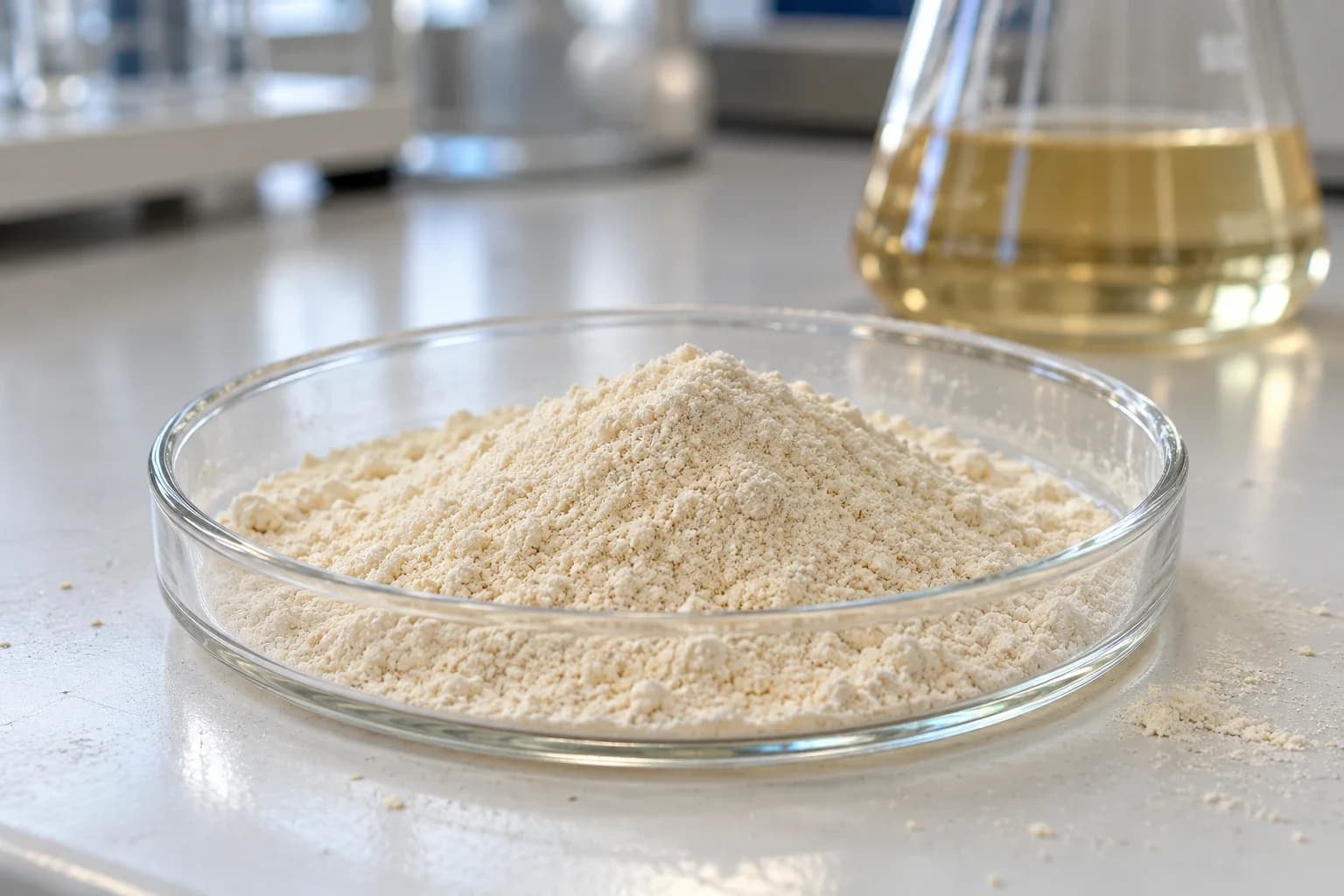
Leptospira Medium Base EMJH
Also known as:EMJH Medium Base · Ellinghausen-McCullough-Johnson-Harris Medium Base · EMJH Base
For the cultivation and maintenance of Leptospira species, following the addition of Leptospira Enrichment EMJH.
- Category
- Dehydrated Culture Media
- Dissolve per litre
- 2.55 g
- Pack sizes
- 500 g · 5 kg · 25 kg
- Certifications
- ISO 22000
Data updated:2026-11-06
- Storage
- Store at 10–30 °C in sealed, dry, clean conditions.
- Shelf life
- 36 months from manufacture date when stored as directed.
Overview
Principle
The medium is based on the oleic acid–albumin formulation of Ellinghausen and McCullough, as modified by Johnson and Harris.¹ʼ² The base supplies phosphate buffer, sodium chloride for osmotic balance, ammonium chloride as the nitrogen source, and thiamine, a vitamin required by leptospires. Leptospira species cannot utilise carbohydrates and depend on long-chain fatty acids as their source of carbon and energy. These are provided by polysorbate 80 in the enrichment, while bovine serum albumin binds the free fatty acids and releases them gradually, protecting the organisms from their toxic effect.¹ The enrichment also supplies vitamin B12 and the trace metals required for growth. Growth is slow and does not produce turbidity in the early stages; cultures are examined periodically by dark-field microscopy for motile spirochaetes.²
Directions
Suspend 2.3 g of powder in 900 mL of purified water. Heat with continuous stirring and bring to the boil for 1 minute. Sterilize by autoclaving at 121°C for 15 minutes. Cool to room temperature and aseptically add 100 mL of Leptospira Enrichment EMJH. Mix well and dispense into sterile tubes. For a semi-solid medium, add 1.5 g of agar per litre before heating. Test the finished medium for performance using stable, standard control cultures.
Product highlights
- Food-grade raw materials, produced in an ISO 22000 certified facility
- Manufactured to the standard formulation, 2.55 g per litre
- Available in 500 g / 5 kg / 25 kg, from laboratory to industrial scale
- COA, specification sheet, and technical data sheet available; samples on request
- Manufactured in Taiwan with reliable supply
Food grade versus laboratory grade
Most culture media suppliers use laboratory-grade raw materials, which are held to lower standards for heavy metal residues, microbial contamination control, and traceability. That is adequate for pure research but not for applications with stricter raw-material requirements. STBIO manufactures with food-grade raw materials throughout, in a facility certified to ISO 22000 food safety management.
- Food microbiology laboratories working to ISO 17025 or equivalent requirements
- Biotech manufacturers exporting fermentation products and needing full raw-material traceability
- Organisations with ESG or compliance audit requirements across their supply chain
- Companies sourcing both Halal and non-Halal products who need one consistent material grade
Frequently asked questions
01How much powder per litre?
Use 2.55 g per litre of deionised water; preparation and sterilisation conditions are given on the specification sheet.
02Which organisms is it suitable for?
Pathogens, Gram-negative, Aerobes. See the cultural response table and the specification sheet.
03Can it be used for food-grade applications?
Yes. It is made from food-grade raw materials in an ISO 22000 certified facility and is suitable for culturing starters for fermented products that are consumed directly.
04How is this product prepared?
Suspend 2.3 g of powder in 900 mL of purified water. Heat with continuous stirring and bring to the boil for 1 minute. Sterilize by autoclaving at 121°C for 15 minutes. Cool to room temperature and aseptically add 100 mL of Leptospira Enrichment EMJH. Mix well and dispense into sterile tubes. For a semi-solid medium, add 1.5 g of agar per litre before heating. Test the finished medium for performance using stable, standard control cultures.
05How should it be stored, and what is the shelf life?
Store at 10–30 °C in sealed, dry, clean conditions. 36 months from manufacture date when stored as directed.
06How do I request a bulk quotation, and can you provide a COA?
Yes. This product is available in 500 g, 5 kg, 25 kg. Tell us your application and volume when requesting a quotation; we reply within one working day and can supply the COA, specification sheet, and technical data sheet.
References
- 1. Ellinghausen H. C. and McCullough W. G., 1965. Nutrition of Leptospira pomona and growth of 13 other serotypes: fractionation of oleic albumin complex and a medium of bovine albumin and polysorbate 80. Am. J. Vet. Res., 26:45-51.
- 2. Johnson R. C. and Harris V. G., 1967. Differentiation of pathogenic and saprophytic leptospires. I. Growth at low temperatures. J. Bacteriol., 94:27-31.