
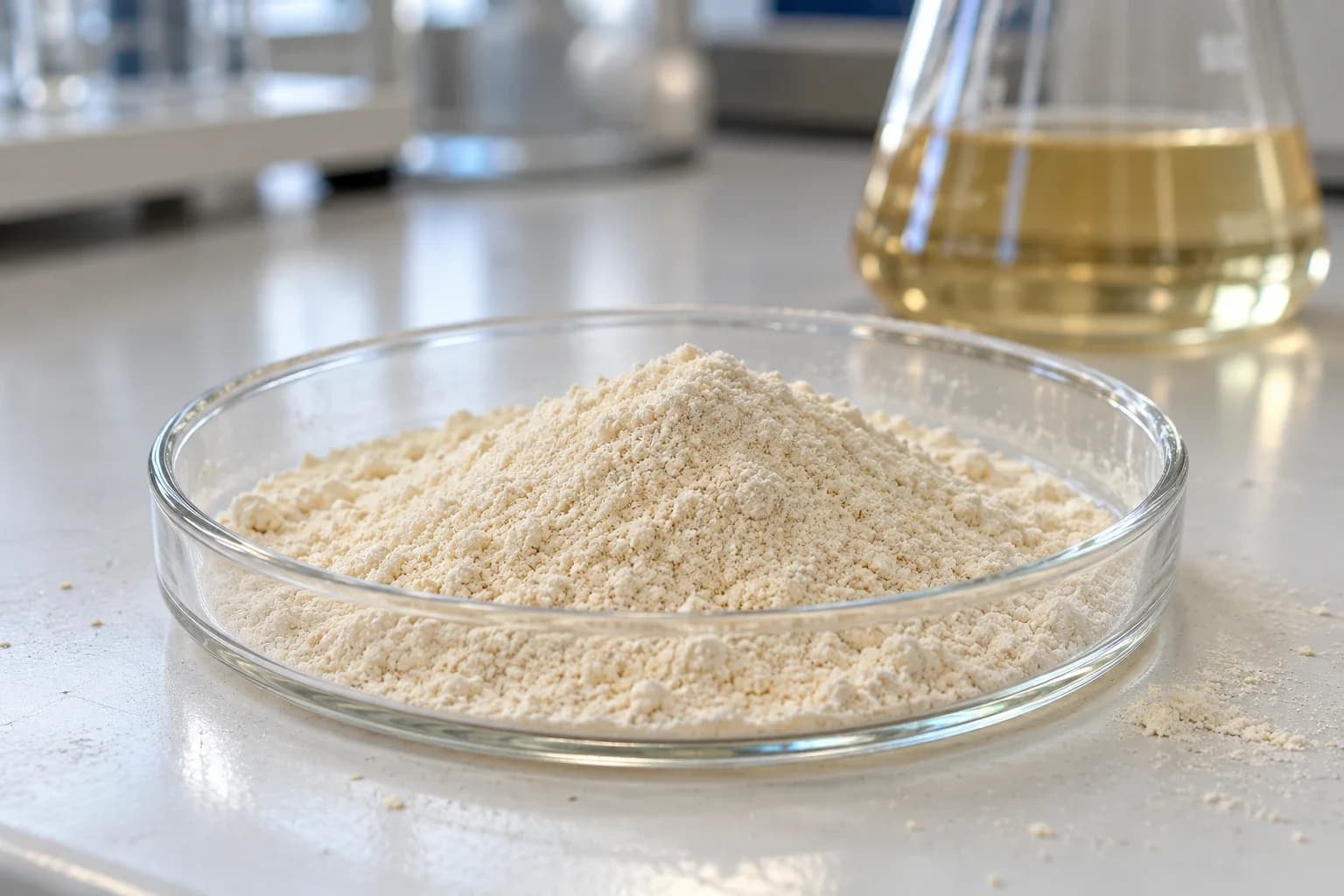
King's Medium B Base
Also known as:KB · King's B Medium · Pseudomonas Agar F · Difco Pseudomonas Agar F · KB Medium · KB Agar
For the non-selective isolation, cultivation, and pigment production of Pseudomonas species from food, water, and cosmetic samples.
- Category
- Dehydrated Culture Media
- Dissolve per litre
- 43 g
- Pack sizes
- 500 g · 5 kg · 25 kg
- Certifications
- Halal
Data updated:2026-11-06
Overview
King's Medium B Base is a base medium to which supplements are added per the method. It is used to induce and detect fluorescent pigment of Pseudomonas. STBIO manufactures it from food-grade raw materials in an ISO 22000 certified facility, with a COA for every batch. This is the Halal-certified version.
Principle
Pseudomonas aeruginosa characteristically secretes several diffusible pigments, including the blue-green pyocyanin, the fluorescent yellow-green pyoverdin (fluorescein), and the reddish-brown pyorubin.¹ King's Medium B Base is formulated to favor the production of fluorescein. Proteose peptone supplies the nitrogen, amino acids, and carbon required for growth, and contributes the phosphorus that stimulates fluorescein synthesis.² The medium contains no added iron; because pyoverdin functions as a siderophore in bacterial iron-uptake systems, its synthesis is markedly up-regulated under iron-limited conditions.² Glycerol serves as the energy source and further enhances pigment formation, while the high phosphate content provided by dipotassium phosphate increases fluorescent-pigment production. Magnesium sulfate supplies essential ions for fluorescein synthesis. This formulation is the basis for distinguishing King's Medium B (favoring fluorescein) from King's Medium A (favoring pyocyanin).¹ After incubation, fluorescein-producing colonies display a characteristic yellow-green fluorescence under ultraviolet light, supporting the presumptive identification of Pseudomonas aeruginosa.³ The medium is also applied in plant bacteriology, where Agrobacterium species are distinguished as non-fluorescent, tumor-inducing organisms on this medium.⁴
Directions
Suspend 43.0 g of the powder in 1 L of purified water containing 15 mL of glycerol. Heat with continuous stirring and bring to the boil for 1 minute. Sterilize by autoclaving at 121°C for 15 minutes. Cool to 45-50°C and aseptically pour into sterile Petri plates. Test the finished medium for performance using stable, standard control cultures.
Cultural response
| Test organism | ATCC | Growth |
|---|---|---|
| Pseudomonas aeruginosa | 27853 | good-luxuriant |
| Pseudomonas aeruginosa | 17934 | good-luxuriant |
| Pseudomonas fluorescens | 13525 | good-luxuriant |
| Escherichia coli | 25922 | good-luxuriant |
| Burkholderia cepacia | 25609 | good |
Product highlights
- Halal certified, suitable for the Malaysian, Indonesian, and Middle Eastern markets
- Manufactured to the standard formulation, 43 g per litre
- Performance verified against standard control strains before release (Pseudomonas aeruginosa, Pseudomonas aeruginosa, Pseudomonas fluorescens, Escherichia coli, Burkholderia cepacia)
- Available in 500 g / 5 kg / 25 kg, from laboratory to industrial scale
- COA, specification sheet, and technical data sheet available; samples on request
- Manufactured in Taiwan with reliable supply
Frequently asked questions
01How much powder per litre?
Use 43 g per litre of deionised water; preparation and sterilisation conditions are given on the specification sheet.
02Which organisms is it suitable for?
Pseudomonas aeruginosa, Pseudomonas fluorescens, Escherichia coli, Burkholderia cepacia. See the cultural response table and the specification sheet.
03How is this product prepared?
Suspend 43.0 g of the powder in 1 L of purified water containing 15 mL of glycerol. Heat with continuous stirring and bring to the boil for 1 minute. Sterilize by autoclaving at 121°C for 15 minutes. Cool to 45-50°C and aseptically pour into sterile Petri plates. Test the finished medium for performance using stable, standard control cultures.
04How do I request a bulk quotation, and can you provide a COA?
Yes. This product is available in 500 g, 5 kg, 25 kg. Tell us your application and volume when requesting a quotation; we reply within one working day and can supply the COA, specification sheet, and technical data sheet.
Used in these applications
References
- 1. King E. O., Ward M. K. and Raney D. E., 1954. J. Lab. Clin. Med., 44:301.
- 2. MacFaddin J. F., 1985. Media for Isolation-Cultivation-Identification-Maintenance of Medical Bacteria, Williams & Wilkins, Baltimore.
- 3. Murray P. R., Baron E. J. et al. (Eds.), Manual of Clinical Microbiology, ASM Press, Washington, D.C.
- 4. Schaad N. W., Jones J. B. and Chun W., 2001. Laboratory Guide for Identification of Plant Pathogenic Bacteria, 3rd Ed., APS Press, St. Paul, MN.