
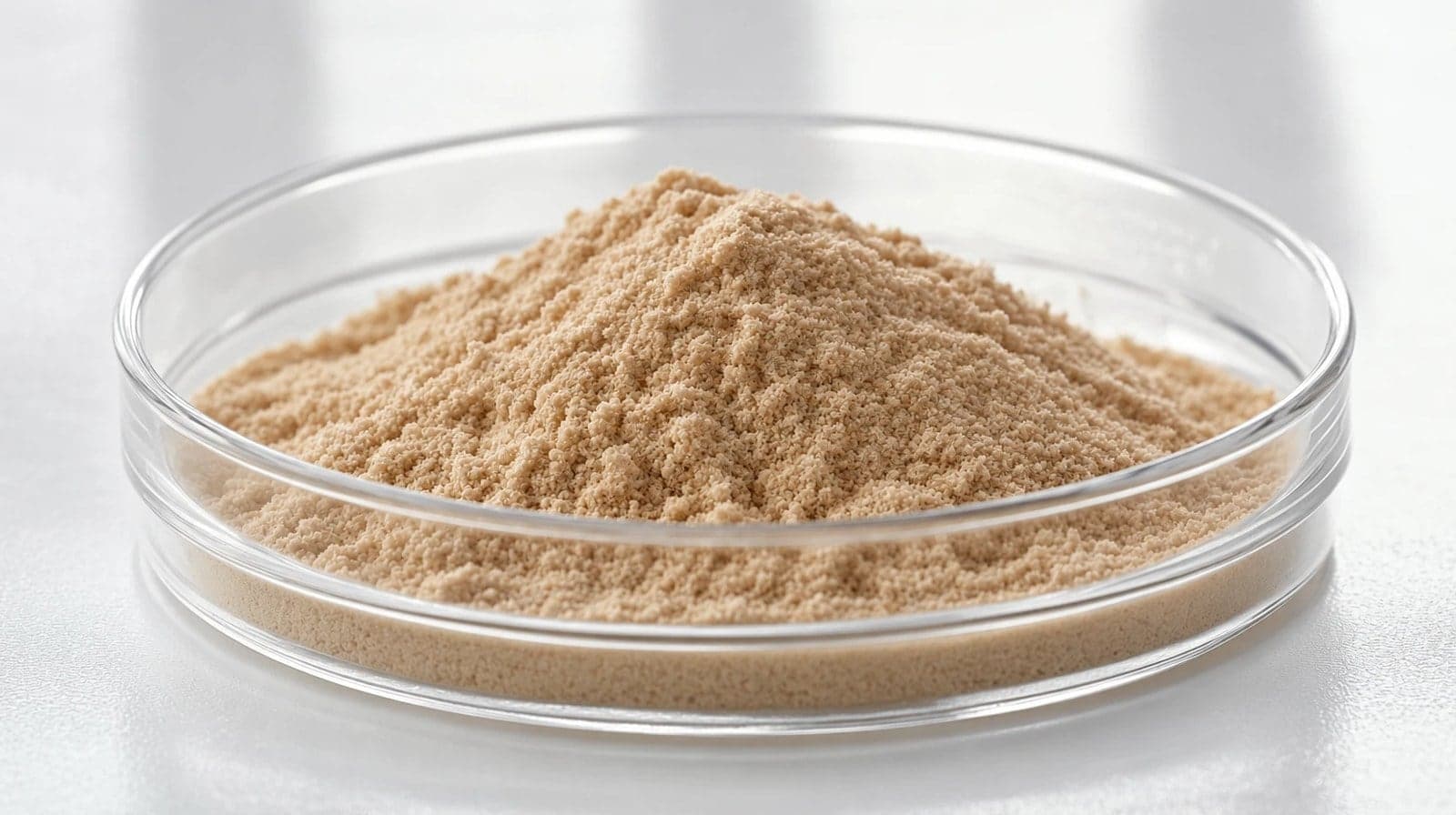
Tryptose Sulfite Cycloserine Agar
Also known as:TSC · TSC Agar · TSC Agar Base · Tryptose Sulphite Cycloserine Agar Base · Perfringens Agar Base · SFP Agar Base
For the enumeration of Clostridium perfringens in food and animal feed, following the addition of D-cycloserine.
- Category
- Dehydrated Culture Media
- Dissolve per litre
- 42 g
- Pack sizes
- 500 g · 5 kg · 25 kg
- Certifications
- ISO 22000 · Halal
- Standard methods
- ISO 7937
Data updated:2026-11-07
Brand cross-reference:BD Difco TSC Agar · Oxoid Perfringens Agar Base (TSC) · Merck TSC Agar(ISO 7937) Brand cross-reference
Overview
Tryptose Sulfite Cycloserine Agar (TSC) is the standard count plate for Clostridium perfringens: D-cycloserine suppresses most competing flora, and sodium sulfite with ferric ammonium citrate turns sulfite-reducing clostridia into black colonies, counted after anaerobic incubation by pour plate or overlay. Specified by the Taiwan FDA C. perfringens method, ISO 7937 and the FDA BAM, it is a routine item for cooked meats, boxed meals and ready-to-eat foods. Add cycloserine after cooling, as the method directs. Food-grade raw materials, Halal certified.
Principle
Tryptose Sulfite Cycloserine Agar was developed by Harmon and co-workers for the enumeration of Clostridium perfringens in foods.¹ Tryptose, soy peptone, and yeast extract supply nitrogen, amino acids, vitamins, and growth factors. Sodium metabisulphite and ferric ammonium citrate act as an indicator of sulphite reduction: sulphite-reducing clostridia reduce sulphite to sulphide, which reacts with iron to form black iron sulphide, so that colonies appear black. D-Cycloserine inhibits facultatively anaerobic competitors and restricts the size and spread of colonies, improving counting accuracy. Plates are prepared by the pour-plate technique with an overlay and incubated anaerobically. Characteristic black colonies are counted as presumptive Clostridium perfringens and confirmed by appropriate tests.²
Media for anaerobes and fastidious organisms
Anaerobes and fastidious organisms require media containing reducing agents, blood, or infusion components, together with an anaerobic incubation environment. Some formulations need heat-labile supplements such as blood, serum, or antibiotics added after sterilisation; follow the preparation instructions for the timing and method.
Directions
Suspend 42 g of powder in 1 L of purified water. Heat with continuous stirring and bring to the boil for 1 minute. Sterilize by autoclaving at 121°C for 15 minutes. Cool to 45-50°C and aseptically add filter-sterilized D-cycloserine to a final concentration of 400 mg/L. Mix well and use for the pour-plate technique with an overlay of the same medium. Test the finished medium for performance using stable, standard control cultures.
Cultural response
| Test organism | ATCC | Growth |
|---|---|---|
| Clostridium perfringens | 13124 | good-luxuriant |
| Clostridium sporogenes | 19404 | good |
| Escherichia coli | 25922 | inhibited |
Product highlights
- Food-grade raw materials, produced in an ISO 22000 certified facility
- Halal certified, suitable for the Malaysian, Indonesian, and Middle Eastern markets
- Manufactured to the standard formulation, 42 g per litre
- Performance verified against standard control strains before release (Clostridium perfringens, Clostridium sporogenes, Escherichia coli)
- Available in 500 g / 5 kg / 25 kg, from laboratory to industrial scale
- COA, specification sheet, and technical data sheet available; samples on request
- Manufactured in Taiwan with reliable supply
Food grade versus laboratory grade
Most culture media suppliers use laboratory-grade raw materials, which are held to lower standards for heavy metal residues, microbial contamination control, and traceability. That is adequate for pure research but not for applications with stricter raw-material requirements. STBIO manufactures with food-grade raw materials throughout, in a facility certified to ISO 22000 food safety management.
- Food microbiology laboratories working to ISO 17025 or equivalent requirements
- Biotech manufacturers exporting fermentation products and needing full raw-material traceability
- Organisations with ESG or compliance audit requirements across their supply chain
- Companies sourcing both Halal and non-Halal products who need one consistent material grade
FDA BAM methods
This product corresponds to a medium used in the chapters of the US FDA Bacteriological Analytical Manual (BAM), the reference methods for FDA regulatory testing. Follow the current online edition of each chapter.
- FDA BAM Chapter 16: Clostridium perfringensBAM Chapter 16Count plateNamed in the method as:Tryptose-sulfite-cycloserine (TSC) agar
BAM specifies methods and media formulations; it does not certify brands. Add supplements as the chapter requires, and verify media against reference strains under your quality system.
Frequently asked questions
01Does this medium meet FDA BAM methods?
BAM specifies methods and formulations, not brands. This product corresponds to a medium used in: FDA BAM Chapter 16: Clostridium perfringens(BAM Chapter 16): Count plate. It is manufactured to the standard formulation and ships with a COA per batch; add supplements as the chapter requires and follow the current online edition.
02How much powder per litre?
Use 42 g per litre of deionised water; preparation and sterilisation conditions are given on the specification sheet.
03Which organisms is it suitable for?
Anaerobes, Spore formers, Gram-positive, Pathogens, C. perfringens, Clostridium perfringens, Clostridium sporogenes, Escherichia coli. See the cultural response table and the specification sheet.
04What are the equivalent brand products and standard methods?
Cross-reference: BD Difco TSC Agar, Oxoid Perfringens Agar Base (TSC), Merck TSC Agar. Standard methods: ISO 7937. Formulations may differ slightly between makers; refer to the specification sheet.
05Can it be used for food-grade applications?
Yes. It is made from food-grade raw materials in an ISO 22000 certified facility and is suitable for culturing starters for fermented products that are consumed directly.
06How is this product prepared?
Suspend 42 g of powder in 1 L of purified water. Heat with continuous stirring and bring to the boil for 1 minute. Sterilize by autoclaving at 121°C for 15 minutes. Cool to 45-50°C and aseptically add filter-sterilized D-cycloserine to a final concentration of 400 mg/L. Mix well and use for the pour-plate technique with an overlay of the same medium. Test the finished medium for performance using stable, standard control cultures.
07How do I request a bulk quotation, and can you provide a COA?
Yes. This product is available in 500 g, 5 kg, 25 kg. Tell us your application and volume when requesting a quotation; we reply within one working day and can supply the COA, specification sheet, and technical data sheet.
Further reading
- FDA BAM Culture Media Cross-Reference: Which Media Each BAM Chapter Uses and the STBIO EquivalentAerobic plate count, coliforms and E. coli, Salmonella, Listeria monocytogenes, Staphylococcus aureus, Bacillus cereus, Vibrio, Clostridium perfringens, yeasts and moulds and Cronobacter: the media named in each FDA Bacteriological Analytical Manual chapter, matched to Taiwan-made dehydrated media for US laboratories qualifying a second source.
- Which Culture Media Do Taiwan FDA Food Microbiology Methods Specify? Cross-Reference for 21 Announced MethodsAerobic plate count, coliforms, E. coli, Enterobacteriaceae, Salmonella, Staphylococcus aureus, Listeria monocytogenes, lactic acid bacteria, yeasts and moulds, Bacillus cereus, Vibrio parahaemolyticus, Clostridium perfringens and Cronobacter: the media named in each Taiwan FDA (TFDA) announced method, matched to Taiwan-made products.
References
- 1. Harmon S. M., Kautter D. A. and Peeler J. T., 1971. Improved medium for enumeration of Clostridium perfringens. Appl. Microbiol., 22:688-692.
- 2. ISO 7937, Microbiology of food and animal feeding stuffs — Horizontal method for the enumeration of Clostridium perfringens — Colony-count technique, International Organization for Standardization, Geneva.