
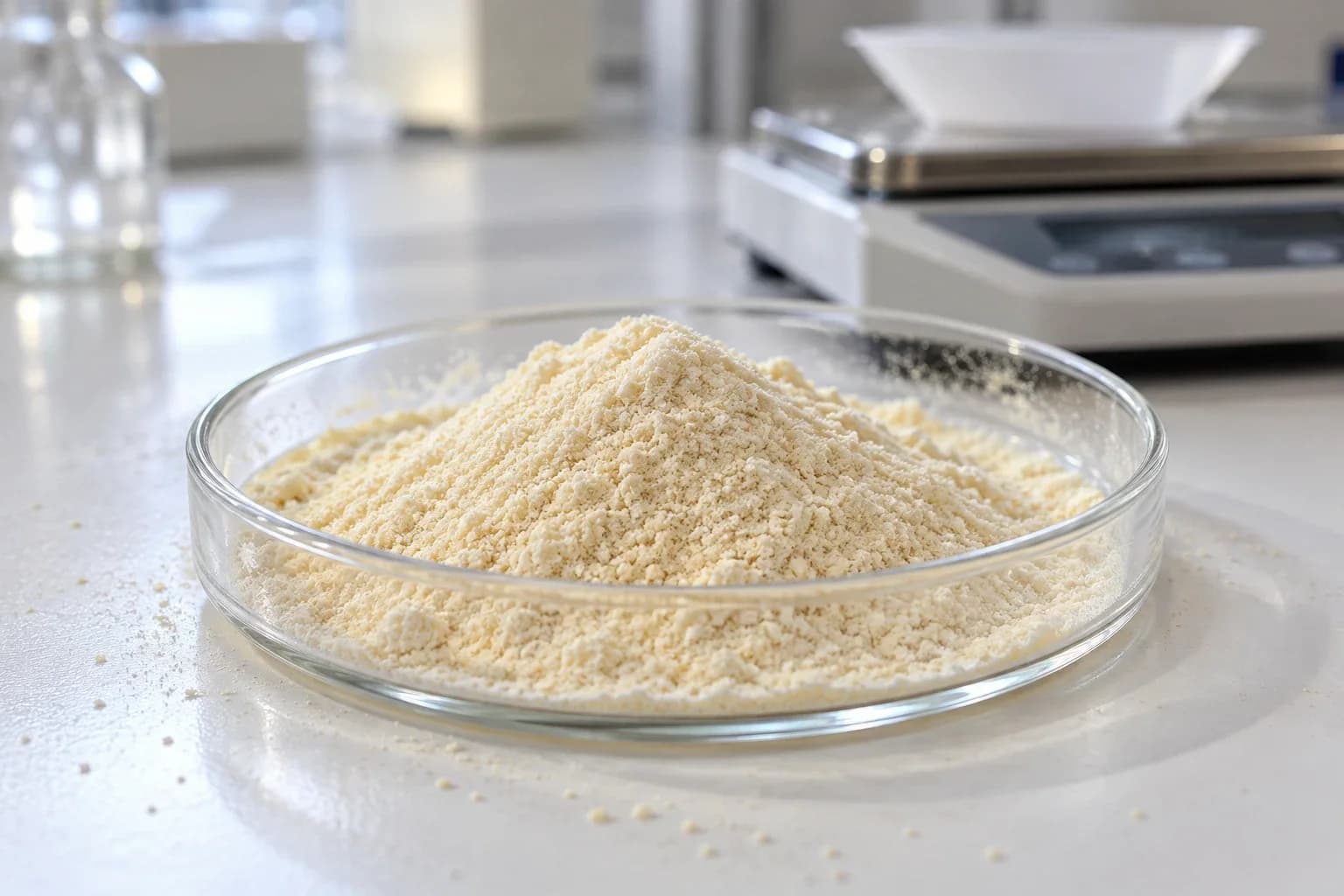
Soy Peptone K28
Soy Peptone K28 is used as a nutrient source in various types of fermentation including lactic acid cultures, pharmaceutical production and bioremediation.
- Category
- Peptones & Protein Hydrolysates
- Pack sizes
- 500 g · 5 kg · 25 kg
- Raw material
- Soy
- Certifications
- ISO 22000 · Halal · Non-GMO · Animal-free
Data updated:2026-11-06
- Storage
- Store at 10–30 °C in sealed, dry, clean conditions.
- Shelf life
- 24 months from manufacture date when stored as directed.
- Allergens
- Soy
Overview
Soy Peptone K28 is a fine beige powder. It contains readily and easily absorbable peptides, amino acids, nucleotides and other growth factors.
How soy peptone grades differ
Soy peptone is enzymatically hydrolysed soy protein, the plant nitrogen source in TSB and other general formulations, and the most common replacement for meat peptones. Grades in a range differ in degree of hydrolysis (amino-to-total nitrogen ratio), molecular weight distribution, carbohydrate content and clarity: more hydrolysed grades are taken up faster and suit start-up and high-density fermentation, less hydrolysed grades carry more peptides and release nitrogen longer. For cell culture choose a grade labelled clear or ultrafiltered. Soy is a declarable allergen; non-GMO raw material is marked on the product page.
Product highlights
- Food-grade raw materials, produced in an ISO 22000 certified facility
- Halal certified, suitable for the Malaysian, Indonesian, and Middle Eastern markets
- Animal-origin-free (AOF)
- Available in 500 g / 5 kg / 25 kg, from laboratory to industrial scale
- COA, specification sheet, and technical data sheet available; samples on request
- Manufactured in Taiwan with reliable supply
Food grade versus laboratory grade
Most culture media suppliers use laboratory-grade raw materials, which are held to lower standards for heavy metal residues, microbial contamination control, and traceability. That is adequate for pure research but not for applications with stricter raw-material requirements. STBIO manufactures with food-grade raw materials throughout, in a facility certified to ISO 22000 food safety management.
- Food microbiology laboratories working to ISO 17025 or equivalent requirements
- Biotech manufacturers exporting fermentation products and needing full raw-material traceability
- Organisations with ESG or compliance audit requirements across their supply chain
- Companies sourcing both Halal and non-Halal products who need one consistent material grade
Frequently asked questions
01Can soy peptone replace tryptone?
In fermentation and routine culture it usually can, with the advantage of no milk allergen and no animal components. Do not substitute it directly in formulations where a standard method specifies tryptone (LB, the indole test), as tryptophan content and peptide profile differ and results may shift.
02Is it free of animal-derived components?
Yes. This product is animal-origin-free, suitable for animal-free formulations and Halal requirements; a declaration is available on request.
03Is the raw material non-GMO?
Yes. The raw material is non-GMO; the supplier declaration can be provided with the COA.
04Can it be used for food-grade applications?
Yes. It is made from food-grade raw materials in an ISO 22000 certified facility and is suitable for culturing starters for fermented products that are consumed directly.
05How should it be stored, and what is the shelf life?
Store at 10–30 °C in sealed, dry, clean conditions. 24 months from manufacture date when stored as directed.
06How do I request a bulk quotation, and can you provide a COA?
Yes. This product is available in 500 g, 5 kg, 25 kg. Tell us your application and volume when requesting a quotation; we reply within one working day and can supply the COA, specification sheet, and technical data sheet.
Academic citation
Products from this range have been cited as the culture media source in a peer-reviewed study by a National Taiwan University research team:
Chan et al. (2024). Single-strain probiotics enhance growth, anti-pathogen immunity, and resistance to Nocardia seriolae in grey mullet (Mugil cephalus) via gut microbiota modulation. Animal Microbiome, 6, 67. Springer Nature.
Media attribution: Tryptone Soy Broth, MRS medium, LB broth, beef extract, peptone, yeast extract, agar (STBIO, New Taipei, Taiwan)
Read the full paperUsed in these applications
- Soy milk keeps contaminating your fermenter? Replace it with soy peptone and ISPA stable, sterile, traceable plant nitrogen source in place of in-house soy milk
- Economical & Highly Nutritious Plant Protein SeriesCost-effective, highly nutritious plant protein nitrogen sources with good solubility and consistent quality, replacing poorly soluble soy protein isolate and variable soy milk. For food, agricultural and industrial microbial fermentation.
- Fast-Growth & High-Efficiency Fermentation Nutrient SeriesRich in low-molecular-weight peptides, free amino acids, nucleotides and B vitamins to bring microorganisms into growth quickly, shortening fermentation time and raising line productivity.