
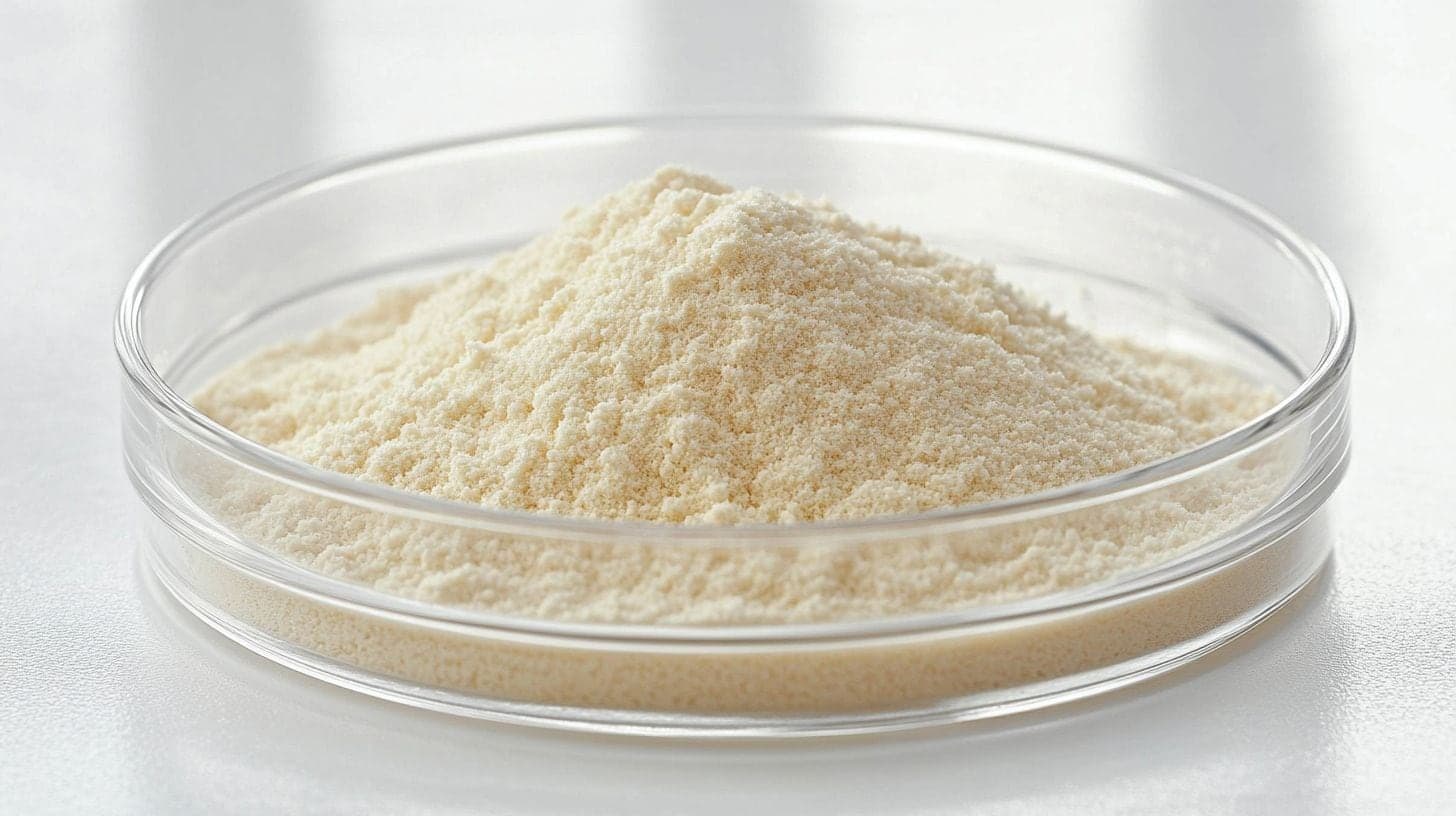
Czapek Dox Agar
Also known as:CDA · Czapek-Dox Agar · Czapek Agar · Czapek Solution Agar · Czapek's Agar
For the cultivation and identification of fungi, particularly Aspergillus and Penicillium species, and of bacteria able to utilise inorganic nitrogen.
- Category
- Dehydrated Culture Media
- Dissolve per litre
- 49.01 g
- Pack sizes
- 500 g · 5 kg · 25 kg
- Certifications
- ISO 22000
Data updated:2026-11-06
Overview
Czapek Dox Agar is an agar (solid) medium, a standard formulation for cultivating yeasts and moulds. It is a defined medium with nitrate as sole nitrogen source, used in the taxonomy of Aspergillus, Penicillium and other filamentous fungi. STBIO manufactures it from food-grade raw materials in an ISO 22000 certified facility, with a COA for every batch.
Principle
Czapek Dox Agar is a semi-synthetic medium derived from the formulation of Czapek and modified by Dox.¹ʼ² Sucrose is the sole source of carbon and sodium nitrate the sole source of nitrogen, so that only organisms able to utilise nitrate as a nitrogen source grow well. Dipotassium hydrogen phosphate buffers the medium, magnesium sulphate and potassium chloride supply essential ions, and ferrous sulphate provides trace iron. Because its composition is chemically defined apart from the agar, the medium gives reproducible colony morphology, conidial colouration, and pigment production, and it is a standard reference medium for the identification of Aspergillus and Penicillium species against published descriptions.³
Choosing a medium for yeasts and moulds
Potato Dextrose Agar and Sabouraud Dextrose Agar are the two general-purpose media most often used for yeasts and moulds. The former promotes mycelial growth and sporulation for morphological work; the latter's low pH itself suppresses bacteria. Malt-based media suit the cultivation and maintenance of yeasts, while the Czapek range is used for the taxonomy of filamentous fungi such as Aspergillus. Broths are for propagation, agars for enumeration and isolation.
Directions
Suspend 49 g of powder in 1 L of purified water. Heat with continuous stirring and bring to the boil for 1 minute. Sterilize by autoclaving at 121°C for 15 minutes. Cool to 45-50°C. Mix well and pour into sterile Petri plates. Test the finished medium for performance using stable, standard control cultures.
Cultural response
| Test organism | ATCC | Growth |
|---|---|---|
| Aspergillus brasiliensis | 16404 | good-luxuriant |
| Aspergillus flavus | 204304 | good-luxuriant |
| Penicillium chrysogenum | good-luxuriant |
Product highlights
- Food-grade raw materials, produced in an ISO 22000 certified facility
- Manufactured to the standard formulation, 49.01 g per litre
- Performance verified against standard control strains before release (Aspergillus brasiliensis, Aspergillus flavus, Penicillium chrysogenum)
- Available in 500 g / 5 kg / 25 kg, from laboratory to industrial scale
- COA, specification sheet, and technical data sheet available; samples on request
- Manufactured in Taiwan with reliable supply
Food grade versus laboratory grade
Most culture media suppliers use laboratory-grade raw materials, which are held to lower standards for heavy metal residues, microbial contamination control, and traceability. That is adequate for pure research but not for applications with stricter raw-material requirements. STBIO manufactures with food-grade raw materials throughout, in a facility certified to ISO 22000 food safety management.
- Food microbiology laboratories working to ISO 17025 or equivalent requirements
- Biotech manufacturers exporting fermentation products and needing full raw-material traceability
- Organisations with ESG or compliance audit requirements across their supply chain
- Companies sourcing both Halal and non-Halal products who need one consistent material grade
Frequently asked questions
01Do I need to suppress bacterial growth in fungal testing?
It depends on the sample. For foods or environmental samples with high bacterial loads, the pH is usually lowered or antibiotics are added to suppress bacteria. Follow the requirements of your chosen method; we are happy to advise.
02How much powder per litre?
Use 49.01 g per litre of deionised water; preparation and sterilisation conditions are given on the specification sheet.
03Which organisms is it suitable for?
Mold, Aspergillus, Penicillium, Aspergillus brasiliensis, Aspergillus flavus, Penicillium chrysogenum. See the cultural response table and the specification sheet.
04Can it be used for food-grade applications?
Yes. It is made from food-grade raw materials in an ISO 22000 certified facility and is suitable for culturing starters for fermented products that are consumed directly.
05How is this product prepared?
Suspend 49 g of powder in 1 L of purified water. Heat with continuous stirring and bring to the boil for 1 minute. Sterilize by autoclaving at 121°C for 15 minutes. Cool to 45-50°C. Mix well and pour into sterile Petri plates. Test the finished medium for performance using stable, standard control cultures.
06How do I request a bulk quotation, and can you provide a COA?
Yes. This product is available in 500 g, 5 kg, 25 kg. Tell us your application and volume when requesting a quotation; we reply within one working day and can supply the COA, specification sheet, and technical data sheet.
Used in these applications
References
- 1. Czapek F., 1902. Untersuchungen über die Stickstoffgewinnung und Eiweißbildung der Pflanzen. Beitr. Chem. Physiol. Pathol., 1:540-560.
- 2. Dox A. W., 1910. The intracellular enzymes of Penicillium and Aspergillus, with special reference to those of Penicillium camemberti. U.S. Dept. Agric. Bur. Anim. Ind. Bull., 120:1-70.
- 3. Raper K. B. and Fennell D. I., 1965. The Genus Aspergillus, Williams & Wilkins, Baltimore.