
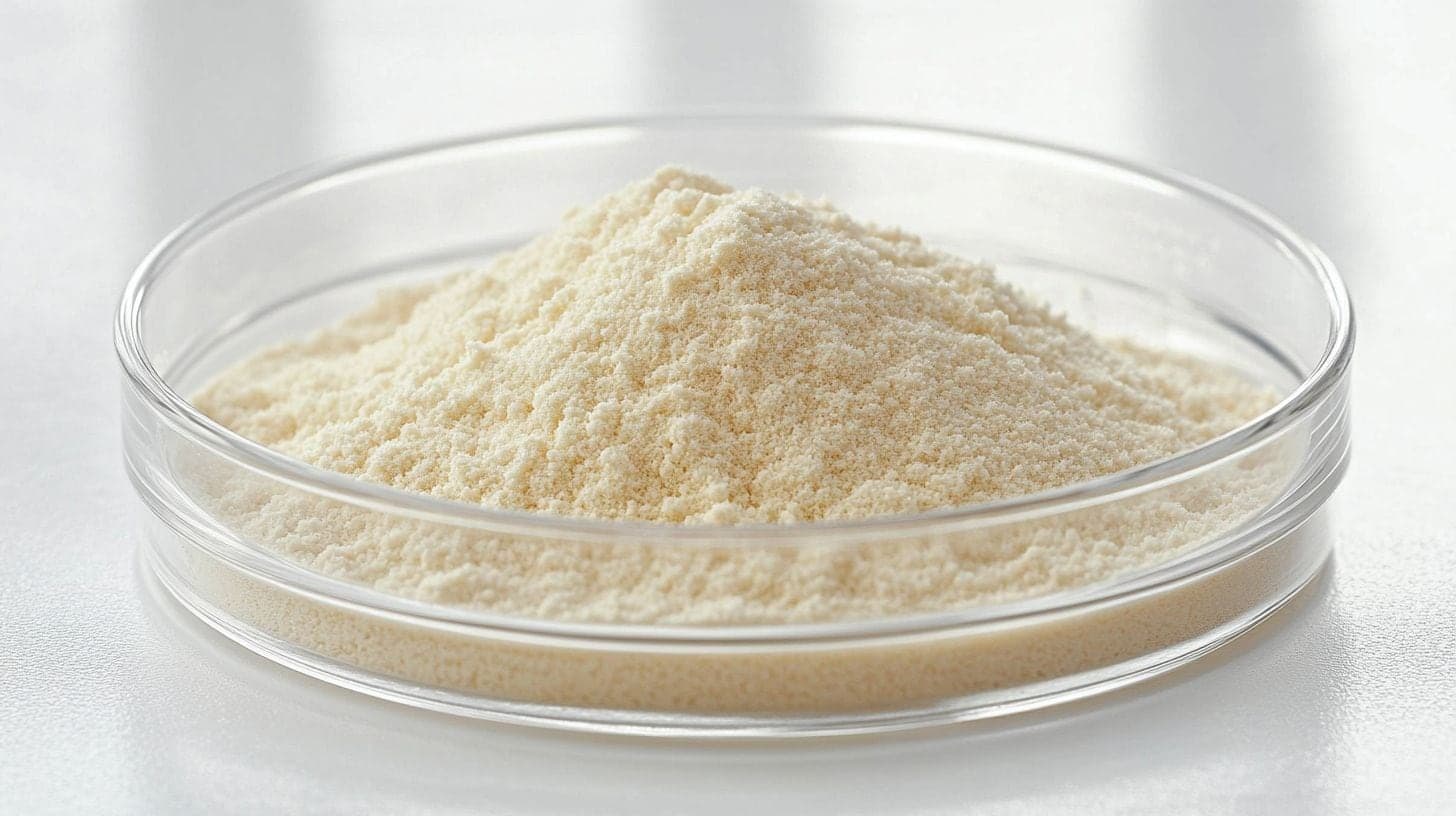
Tryptose
Also known as:Tryptose Peptone · Casein Soy Peptone · Enzymatic Digest of Casein and Soybean Meal
Used as a nutrient source in a wide range of fermentation processes, including lactic acid cultures, pharmaceutical production, and bioremediation.
- Category
- Peptones & Protein Hydrolysates
- pH (25 °C)
- 6.5 – 7.5
- Appearance
- Cream powder
- Pack sizes
- 500 g · 5 kg · 25 kg
- Certifications
- ISO 22000 · Non-GMO · Non-TSE/BSE
Data updated:2026-11-06
- Shelf life
- When stored in sealed containers, at ambient temperature in dry and clean conditions, the expected shelf life is 2 years.
Overview
A fine cream, water-soluble powder produced by controlled enzymatic hydrolysis of casein and soybean meal. Rich in readily assimilable peptides and amino acids, it also supplies soluble vitamins, minerals, and growth factors. Raw materials are of animal (milk) and plant (soy) origin.
Specifications
| Parameter | Specification |
|---|---|
| Appearance | Cream powder |
| Total nitrogen TN | 10.5 – 12.0% |
| pH (2 % solution) | 6.5 – 7.5 |
| Loss on drying | ≤ 8.0 % |
| Chlorides (as NaCl) | ≤ 1 % |
| Total aerobic microbial count | ≤10 000 /g |
| Staphylococcus aureus | Absence / 10 g |
| Salmonella | Absence / 25 g |
| Escherichia coli | Absence / g |
| Coliforms | ≤ 10 /g |
| Yeasts and moulds | ≤ 100 /g |
Release specifications. Actual values are reported on the COA supplied with each batch.
Product highlights
- Food-grade raw materials, produced in an ISO 22000 certified facility
- Non-GMO
- Available in 500 g / 5 kg / 25 kg, from laboratory to industrial scale
- COA, specification sheet, and technical data sheet available; samples on request
- Manufactured in Taiwan with reliable supply
Food grade versus laboratory grade
Most culture media suppliers use laboratory-grade raw materials, which are held to lower standards for heavy metal residues, microbial contamination control, and traceability. That is adequate for pure research but not for applications with stricter raw-material requirements. STBIO manufactures with food-grade raw materials throughout, in a facility certified to ISO 22000 food safety management.
- Food microbiology laboratories working to ISO 17025 or equivalent requirements
- Biotech manufacturers exporting fermentation products and needing full raw-material traceability
- Organisations with ESG or compliance audit requirements across their supply chain
- Companies sourcing both Halal and non-Halal products who need one consistent material grade
Frequently asked questions
01Which organisms is it suitable for?
Lactic acid bacteria. See the cultural response table and the specification sheet.
02Is the raw material non-GMO?
Yes. The raw material is non-GMO; the supplier declaration can be provided with the COA.
03Can it be used for food-grade applications?
Yes. It is made from food-grade raw materials in an ISO 22000 certified facility and is suitable for culturing starters for fermented products that are consumed directly.
04How should it be stored, and what is the shelf life?
When stored in sealed containers, at ambient temperature in dry and clean conditions, the expected shelf life is 2 years.
05How do I request a bulk quotation, and can you provide a COA?
Yes. This product is available in 500 g, 5 kg, 25 kg. Tell us your application and volume when requesting a quotation; we reply within one working day and can supply the COA, specification sheet, and technical data sheet.
Further reading
- FDA BAM Culture Media Cross-Reference: Which Media Each BAM Chapter Uses and the STBIO EquivalentAerobic plate count, coliforms and E. coli, Salmonella, Listeria monocytogenes, Staphylococcus aureus, Bacillus cereus, Vibrio, Clostridium perfringens, yeasts and moulds and Cronobacter: the media named in each FDA Bacteriological Analytical Manual chapter, matched to Taiwan-made dehydrated media for US laboratories qualifying a second source.
- Which Culture Media Do Taiwan FDA Food Microbiology Methods Specify? Cross-Reference for 21 Announced MethodsAerobic plate count, coliforms, E. coli, Enterobacteriaceae, Salmonella, Staphylococcus aureus, Listeria monocytogenes, lactic acid bacteria, yeasts and moulds, Bacillus cereus, Vibrio parahaemolyticus, Clostridium perfringens and Cronobacter: the media named in each Taiwan FDA (TFDA) announced method, matched to Taiwan-made products.
- Tryptose vs Tryptone: One Letter Apart, Different JobsTryptose is an enzymatic digest of mixed casein and meat protein used in media for fastidious organisms such as Brucella and Listeria. Tryptone is a pancreatic digest of casein alone, used in LB and TSB. Raw material, hydrolysis, specification and the formulations that call for each.