
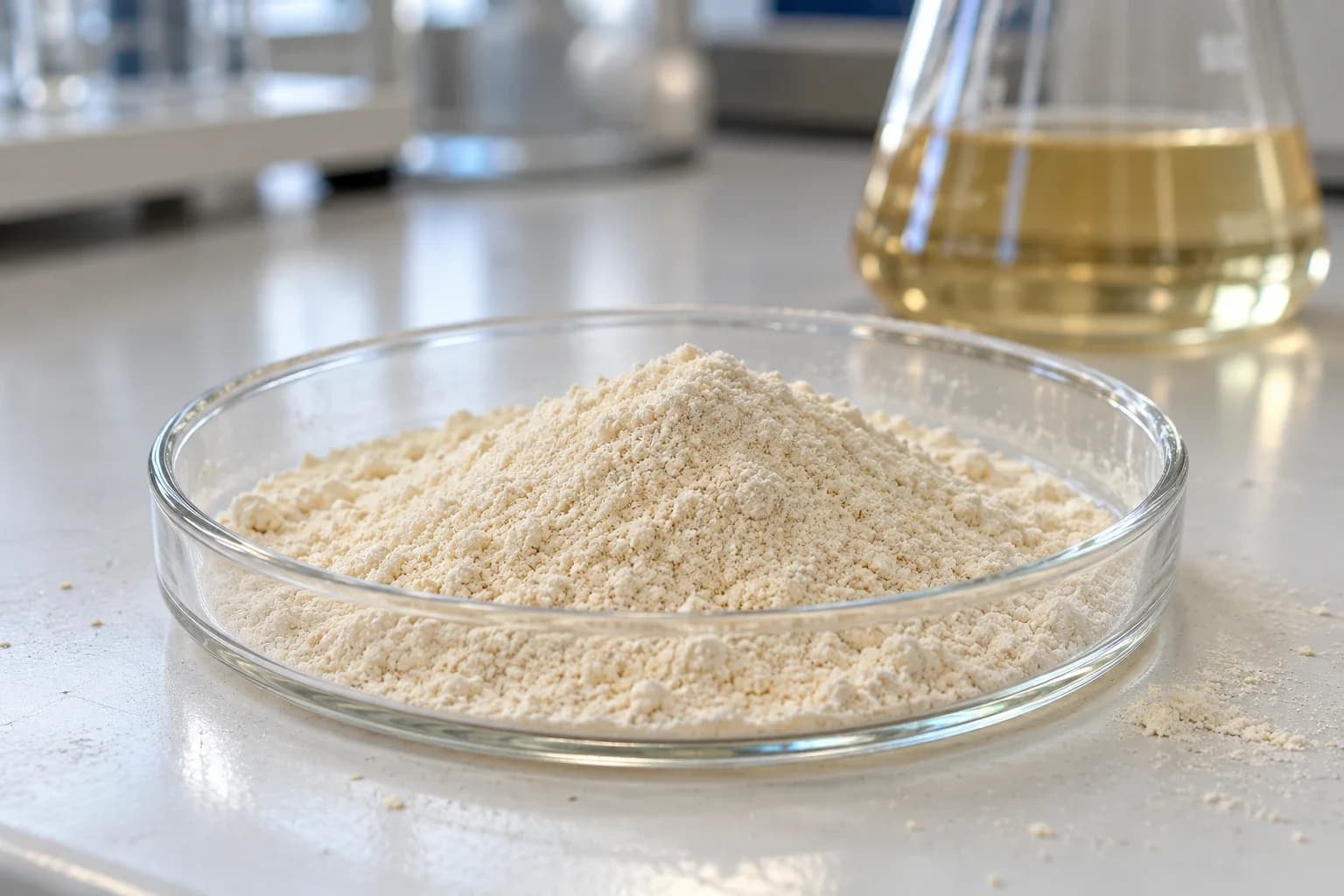
Peptone Water
Also known as:PW · Tryptone Water · Bacteriological Peptone Water
- Category
- Dehydrated Culture Media
- Dissolve per litre
- 15 g
- Pack sizes
- 500 g · 5 kg · 25 kg
- Certifications
- Halal
- Standard methods
- ISO 6887 (diluent)
Data updated:2026-11-07
Brand cross-reference:BD Difco Peptone Water · Oxoid Peptone Water · Merck Peptone Water(ISO 6887 (diluent)) Brand cross-reference
- Allergens
- Soy, Milk
Overview
Peptone Water is a simple liquid medium of peptone and sodium chloride only, with no buffer and no carbohydrate. It is used to dilute and homogenise samples, as the base for the indole test, and with added sugars for carbohydrate fermentation tests; it also serves as a mild enrichment for non-fastidious bacteria. For Salmonella pre-enrichment use the phosphate-buffered Buffered Peptone Water instead.
Choosing between Buffered Peptone Water, Peptone Water and Lactose Broth
All three are liquid media without selective agents; they differ in purpose. Buffered Peptone Water is phosphate-buffered and is the pre-enrichment medium specified by ISO 6579-1 and the FDA BAM for Salmonella, and by standard methods for Cronobacter and others. Peptone Water has no buffer and is used to dilute samples and for indole and sugar fermentation tests. Lactose Broth contains lactose and is the pre-enrichment broth in older FDA BAM editions and some dairy methods. Follow the method you are accredited to; when none is specified, use Buffered Peptone Water for Salmonella.
Product highlights
- Halal certified, suitable for the Malaysian, Indonesian, and Middle Eastern markets
- Manufactured to the standard formulation, 15 g per litre
- Available in 500 g / 5 kg / 25 kg, from laboratory to industrial scale
- COA, specification sheet, and technical data sheet available; samples on request
- Manufactured in Taiwan with reliable supply
Frequently asked questions
01Why does Salmonella testing start with pre-enrichment in Buffered Peptone Water?
Salmonella in food is usually present in low numbers and already injured by heating, freezing, drying or acid; placed straight into a selective medium with inhibitors, the cells die and the test comes back negative. Pre-enrichment in BPW, which has no selective pressure, lets injured cells repair and multiply to detectable numbers before selective enrichment and isolation. That is why ISO 6579-1 makes it the first step.
02What sample ratio and incubation does Buffered Peptone Water use?
Under ISO 6579-1, sample and BPW are mixed 1:9, for example 25 g of sample in 225 mL of BPW, homogenised and incubated at 34 to 38 °C for 18 ± 2 hours before transfer to selective enrichment broths. Follow the edition of the method you are accredited to.
03Can Buffered Peptone Water and Peptone Water be used interchangeably?
Not recommended. The difference is the phosphate buffer: during pre-enrichment the culture produces acid, and in unbuffered Peptone Water the pH drops and hinders recovery of injured cells. Use Peptone Water for sample dilution and the indole test, and the buffered version for Salmonella pre-enrichment.
04How long can prepared Buffered Peptone Water be kept?
Sterilised BPW stored at 2 to 8 °C in the dark generally keeps for about one month; bring it to room temperature and check that it is clear before use. Keep the opened powder tightly sealed and dry, as caked powder drifts in pH and performance. Your own quality system takes precedence.
05How much powder per litre?
Use 15 g per litre of deionised water; preparation and sterilisation conditions are given on the specification sheet.
06What are the equivalent brand products and standard methods?
Cross-reference: BD Difco Peptone Water, Oxoid Peptone Water, Merck Peptone Water. Standard methods: ISO 6887 (diluent). Formulations may differ slightly between makers; refer to the specification sheet.
07How do I request a bulk quotation, and can you provide a COA?
Yes. This product is available in 500 g, 5 kg, 25 kg. Tell us your application and volume when requesting a quotation; we reply within one working day and can supply the COA, specification sheet, and technical data sheet.
Academic citation
Products from this range have been cited as the culture media source in a peer-reviewed study by a National Taiwan University research team:
Chan et al. (2024). Single-strain probiotics enhance growth, anti-pathogen immunity, and resistance to Nocardia seriolae in grey mullet (Mugil cephalus) via gut microbiota modulation. Animal Microbiome, 6, 67. Springer Nature.
Media attribution: Tryptone Soy Broth, MRS medium, LB broth, beef extract, peptone, yeast extract, agar (STBIO, New Taipei, Taiwan)
Read the full paperUsed in these applications
Further reading
- FDA BAM Culture Media Cross-Reference: Which Media Each BAM Chapter Uses and the STBIO EquivalentAerobic plate count, coliforms and E. coli, Salmonella, Listeria monocytogenes, Staphylococcus aureus, Bacillus cereus, Vibrio, Clostridium perfringens, yeasts and moulds and Cronobacter: the media named in each FDA Bacteriological Analytical Manual chapter, matched to Taiwan-made dehydrated media for US laboratories qualifying a second source.
- Which Culture Media Do Taiwan FDA Food Microbiology Methods Specify? Cross-Reference for 21 Announced MethodsAerobic plate count, coliforms, E. coli, Enterobacteriaceae, Salmonella, Staphylococcus aureus, Listeria monocytogenes, lactic acid bacteria, yeasts and moulds, Bacillus cereus, Vibrio parahaemolyticus, Clostridium perfringens and Cronobacter: the media named in each Taiwan FDA (TFDA) announced method, matched to Taiwan-made products.
- The pH of my prepared medium is off. How do I adjust it?First check the measuring conditions: 25 °C, before sterilisation, with a calibrated electrode. Most dehydrated media need no adjustment; when they do, use 1 N NaOH or HCl in small steps.