
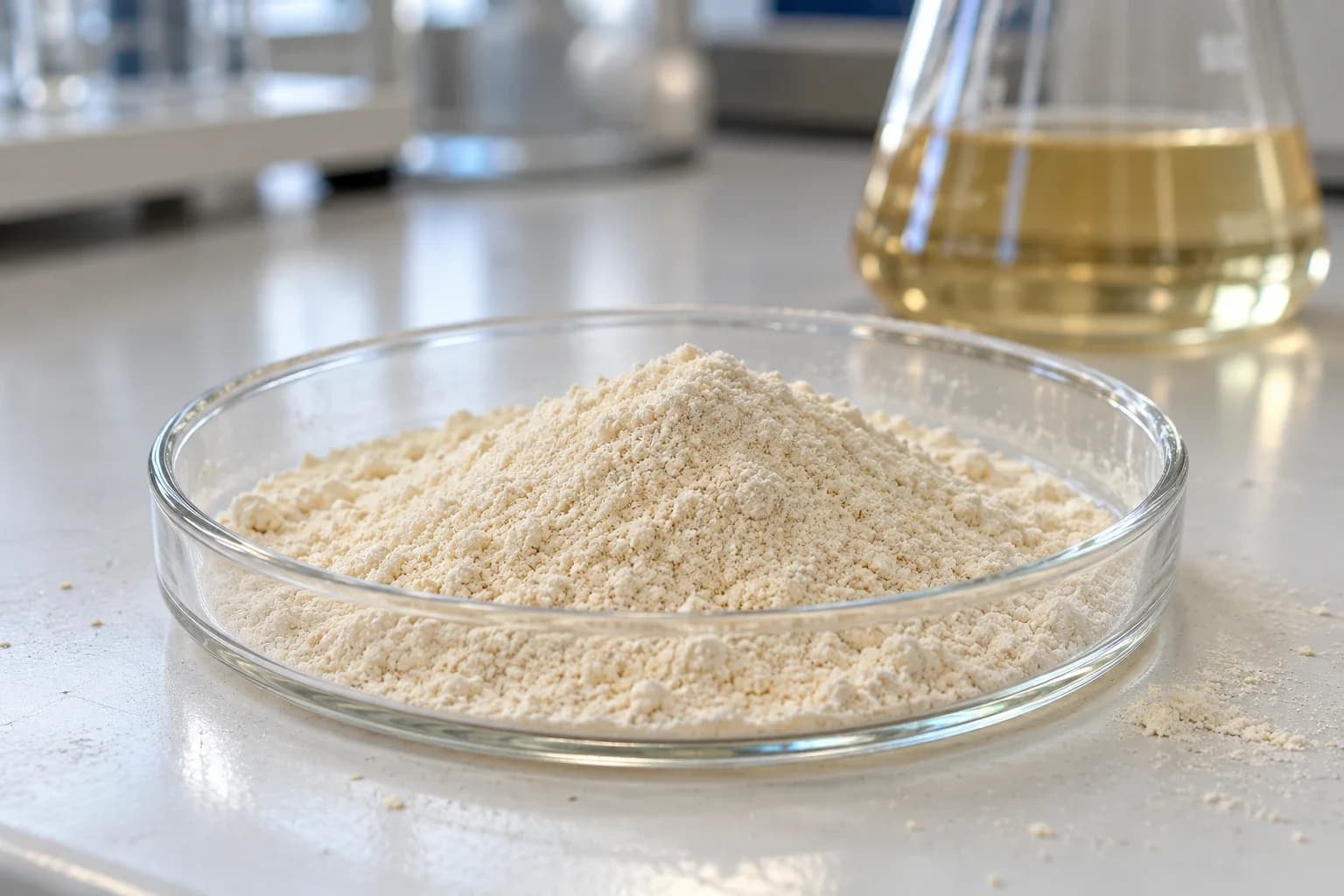
 Illustrative image only. Actual product may vary.
Yeast Extract Peptone Dextrose Broth
Also known as:YPD · YPD Broth H · YPD Broth · YEPD Broth · Yeast Peptone Dextrose Broth · Yeast Extract Peptone Glucose Broth
For the cultivation and propagation of yeasts, including Saccharomyces cerevisiae, in molecular biology and fermentation applications.
- Category
- Dehydrated Culture Media
- Dissolve per litre
- 50 g
- Pack sizes
- 500 g · 5 kg · 25 kg
Data updated:2026-11-24
Overview
Yeast Extract Peptone Dextrose Broth is a broth (liquid) medium. It is the YPD formulation, rich and fast-growing, the standard laboratory medium for yeast. STBIO manufactures it from food-grade raw materials in an ISO 22000 certified facility, with a COA for every batch.
Principle
YPD Broth is the standard rich medium for the routine propagation of yeasts in genetics and molecular biology.¹ Yeast extract supplies B-group vitamins, nucleotides, and growth factors, peptone provides nitrogen, amino acids, and peptides, and dextrose serves as the fermentable carbon and energy source. The medium is non-selective and supports rapid growth to high cell density. It is used for the preparation of starter and seed cultures, for the propagation of transformed strains before transfer to selective media, and for the maintenance of yeast stocks. Growth is indicated by turbidity.²
Directions
Suspend 50 g of powder in 1 L of purified water. Heat with continuous stirring and bring to the boil for 1 minute. Dispense into tubes or flasks. Sterilize by autoclaving at 121°C for 15 minutes. Avoid overheating. Test the finished medium for performance using stable, standard control cultures.
Cultural response
| Test organism | ATCC | Growth |
|---|---|---|
| Saccharomyces cerevisiae | 9763 | good-luxuriant |
| Candida albicans | 10231 | good-luxuriant |
| Schizosaccharomyces pombe | 24843 | good-luxuriant |
Product highlights
- Manufactured to the standard formulation, 50 g per litre
- Performance verified against standard control strains before release (Saccharomyces cerevisiae, Candida albicans, Schizosaccharomyces pombe)
- Available in 500 g / 5 kg / 25 kg, from laboratory to industrial scale
- COA, specification sheet, and technical data sheet available; samples on request
- Manufactured in Taiwan with reliable supply
Frequently asked questions
01How much powder per litre?
Use 50 g per litre of deionised water; preparation and sterilisation conditions are given on the specification sheet.
02Which organisms is it suitable for?
Yeast & Mold, Yeast, Candida, S. cerevisiae, Saccharomyces cerevisiae, Candida albicans, Schizosaccharomyces pombe. See the cultural response table and the specification sheet.
03How is this product prepared?
Suspend 50 g of powder in 1 L of purified water. Heat with continuous stirring and bring to the boil for 1 minute. Dispense into tubes or flasks. Sterilize by autoclaving at 121°C for 15 minutes. Avoid overheating. Test the finished medium for performance using stable, standard control cultures.
04Is there a Halal certified version of this product?
Yes. This is the standard version; a Halal certified version is also produced from food-grade raw materials with Halal documentation, for compliant sourcing in Malaysia, Indonesia, and the Middle East.
05How do I request a bulk quotation, and can you provide a COA?
Yes. This product is available in 500 g, 5 kg, 25 kg. Tell us your application and volume when requesting a quotation; we reply within one working day and can supply the COA, specification sheet, and technical data sheet.
Academic citation
Products from this range have been cited as the culture media source in a peer-reviewed study by a National Taiwan University research team:
Chan et al. (2024). Single-strain probiotics enhance growth, anti-pathogen immunity, and resistance to Nocardia seriolae in grey mullet (Mugil cephalus) via gut microbiota modulation. Animal Microbiome, 6, 67. Springer Nature.
Media attribution: Tryptone Soy Broth, MRS medium, LB broth, beef extract, peptone, yeast extract, agar (STBIO, New Taipei, Taiwan)
Read the full paperUsed in these applications
References
- 1. Sherman F., 2002. Getting started with yeast. Methods Enzymol., 350:3-41.
- 2. Atlas R. M., 2010. Handbook of Microbiological Media, 4th Ed., CRC Press, Boca Raton.