
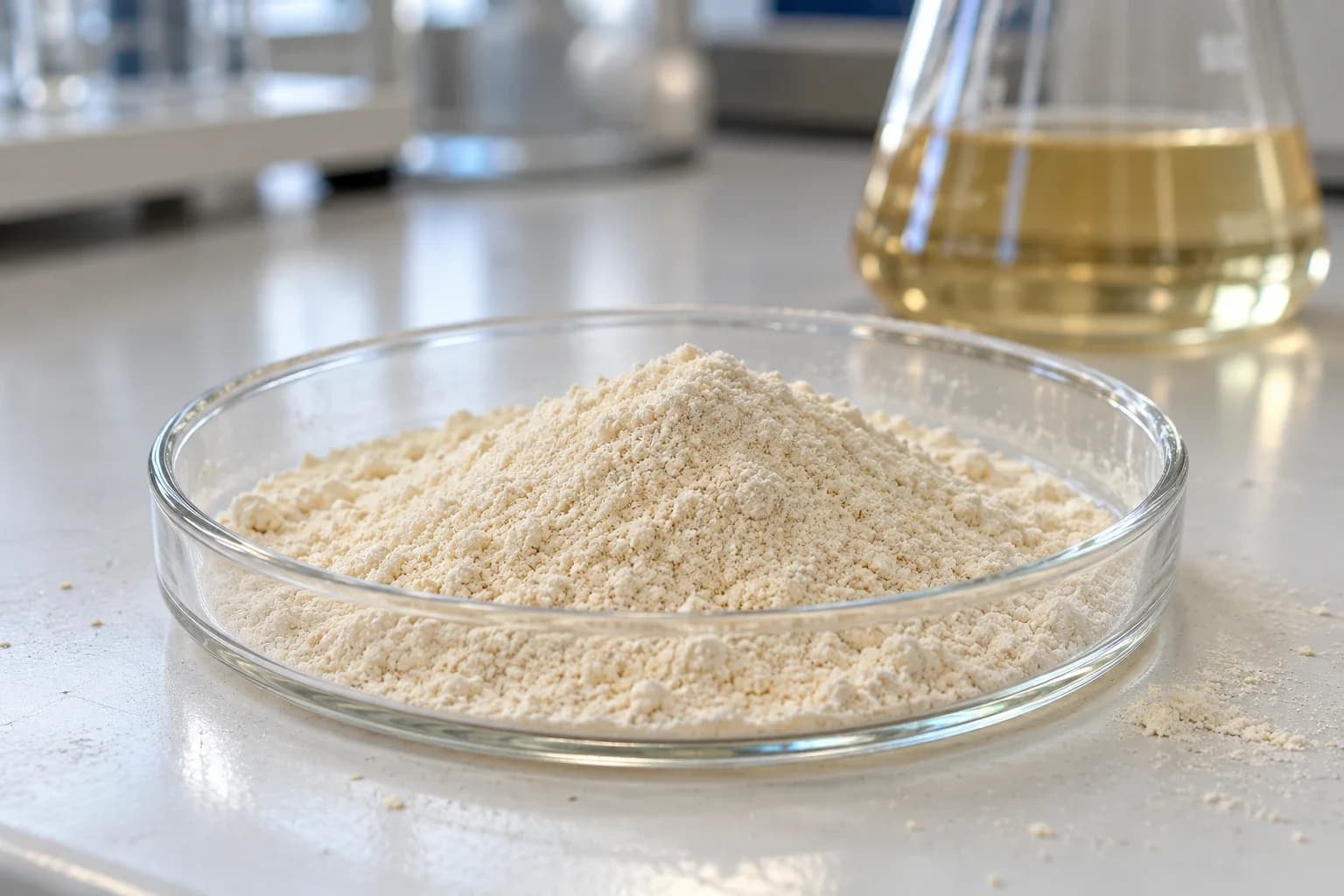
 Illustrative image only. Actual product may vary.
Modified Wakimoto Medium
Also known as:Modified Wakimoto's Agar · Wakimoto's Medium · ATCC Medium 666 · Potato Semi-Synthetic Agar
For the isolation and cultivation of Xanthomonas oryzae pv. oryzae and other plant-pathogenic bacteria.
- Category
- Dehydrated Culture Media
- Pack sizes
- 500 g · 5 kg · 25 kg
Data updated:2026-11-06
Overview
Principle
Modified Wakimoto Medium is a semi-synthetic medium formulated according to Wakimoto for the cultivation of Xanthomonas oryzae pv. oryzae, the causal agent of bacterial leaf blight of rice.¹ Peptone provides nitrogen, amino acids, peptides, and growth factors. Sucrose serves as the carbon and energy source and supports the production of the extracellular polysaccharide that gives colonies their characteristic mucoid appearance. Disodium hydrogen phosphate buffers the medium, calcium nitrate supplies calcium together with an inorganic nitrogen source, and ferrous sulphate provides the iron required for growth. Colonies of Xanthomonas oryzae pv. oryzae appear after 2 to 3 days at 28°C as circular, convex, mucoid, pale yellow to straw-coloured colonies.²
Directions
Suspend 38 g of powder in 1 L of purified water. Heat with continuous stirring and bring to the boil for 1 minute. Sterilize by autoclaving at 121°C for 15 minutes. Avoid overheating to prevent caramelization of sucrose. Cool to 45-50°C. Mix well and pour into sterile Petri plates. Test the finished medium for performance using stable, standard control cultures.
Product highlights
- Available in 500 g / 5 kg / 25 kg, from laboratory to industrial scale
- COA, specification sheet, and technical data sheet available; samples on request
- Manufactured in Taiwan with reliable supply
Frequently asked questions
01Which organisms is it suitable for?
Gram-negative, Plant pathogens, Xanthomonas, Aerobes. See the cultural response table and the specification sheet.
02How is this product prepared?
Suspend 38 g of powder in 1 L of purified water. Heat with continuous stirring and bring to the boil for 1 minute. Sterilize by autoclaving at 121°C for 15 minutes. Avoid overheating to prevent caramelization of sucrose. Cool to 45-50°C. Mix well and pour into sterile Petri plates. Test the finished medium for performance using stable, standard control cultures.
03How do I request a bulk quotation, and can you provide a COA?
Yes. This product is available in 500 g, 5 kg, 25 kg. Tell us your application and volume when requesting a quotation; we reply within one working day and can supply the COA, specification sheet, and technical data sheet.
References
- 1. Wakimoto S., 1960. Classification of strains of Xanthomonas oryzae on the basis of their susceptibility to bacteriophages. Ann. Phytopathol. Soc. Jpn., 25:193-198.
- 2. Mew T. W. and Misra J. K. (Eds.), 1994. A Manual of Rice Seed Health Testing, International Rice Research Institute, Manila.