
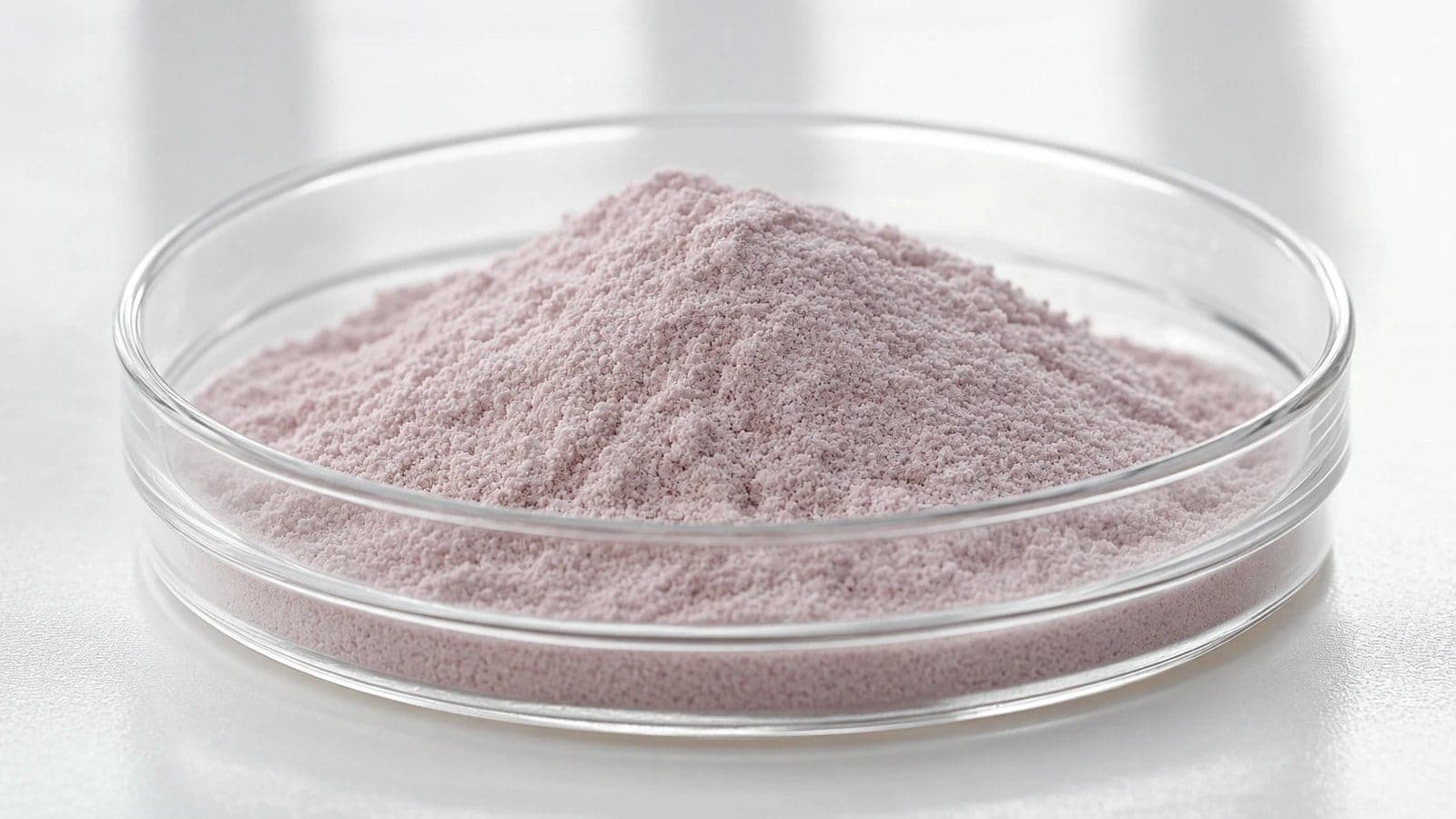
Violet Red Bile Glucose Agar
Also known as:VRBGA · VRBG Agar · Violet Red Bile Dextrose Agar · Crystal Violet Neutral Red Bile Glucose Agar
For the enumeration of Enterobacteriaceae in food, animal feed, and environmental samples.
- Category
- Dehydrated Culture Media
- Dissolve per litre
- 41.53 g
- Pack sizes
- 500 g · 5 kg · 25 kg
- Certifications
- Halal
- Standard methods
- ISO 21528-2
Data updated:2026-11-06
Brand cross-reference:BD Difco Violet Red Bile Glucose Agar · Oxoid Violet Red Bile Glucose Agar (VRBGA) · Merck VRBD Agar(ISO 21528-2) Brand cross-reference
Overview
Violet Red Bile Glucose Agar (VRBGA) is the standard selective medium for detecting and counting Enterobacteriaceae, as specified in ISO 21528. Bile salts and crystal violet suppress Gram-positive organisms, and glucose replaces lactose so every member of the family ferments it, giving purple-red colonies with a precipitate halo, including non-lactose fermenters such as Salmonella that lactose-based VRBA would miss. Used as the hygiene indicator test in food, dairy and environmental samples.
Principle
Violet Red Bile Glucose Agar is a modification of Violet Red Bile Agar in which lactose is replaced by glucose, so that all members of the Enterobacteriaceae, including lactose-negative organisms, are detected.¹ Enzymatic digest of animal tissues and yeast extract supply nitrogen, amino acids, vitamins, and growth factors, and sodium chloride maintains the osmotic equilibrium. Bile salts and crystal violet inhibit Gram-positive bacteria. Glucose is fermented by all Enterobacteriaceae, producing acid that is indicated by neutral red. Characteristic colonies are pink to red or purple, with or without a zone of precipitated bile. The overlay restricts spreading and further suppresses non-target flora. Characteristic colonies are counted and confirmed by the oxidase test and glucose fermentation.²
How selective media fit into the testing workflow
Pathogen testing normally runs in three stages: a pre-enrichment medium such as Buffered Peptone Water repairs injured cells and raises numbers, a selective enrichment then suppresses competing flora, and finally a selective differential agar isolates the target colonies. Selective agents are typically bile salts, dyes, or antibiotics; differential agents make target colonies develop a characteristic colour or morphology. Choose the combination specified by the method you follow.
Directions
Suspend 41.53 g of powder in 1 L of purified water. Heat with continuous stirring and bring to the boil for 1 minute. DO NOT AUTOCLAVE. Cool to 45-50°C and use for the pour-plate technique with an overlay of the same medium. Test the finished medium for performance using stable, standard control cultures.
Cultural response
| Test organism | ATCC | Growth |
|---|---|---|
| Escherichia coli | 25922 | good-luxuriant |
| Salmonella enterica ser. Typhimurium | 14028 | good-luxuriant |
| Staphylococcus aureus | 25923 | inhibited |
| Enterococcus faecalis | 29212 | inhibited |
Product highlights
- Halal certified, suitable for the Malaysian, Indonesian, and Middle Eastern markets
- Manufactured to the standard formulation, 41.53 g per litre
- Performance verified against standard control strains before release (Escherichia coli, Salmonella enterica ser. Typhimurium, Staphylococcus aureus, Enterococcus faecalis)
- Available in 500 g / 5 kg / 25 kg, from laboratory to industrial scale
- COA, specification sheet, and technical data sheet available; samples on request
- Manufactured in Taiwan with reliable supply
Frequently asked questions
01Can selective media be autoclaved?
Not always. Some media containing dyes or selective inhibitors lose their selectivity if overheated and should only be heated until fully dissolved, without autoclaving. Follow the preparation instructions for this product, and contact us if you are unsure.
02How much powder per litre?
Use 41.53 g per litre of deionised water; preparation and sterilisation conditions are given on the specification sheet.
03Which organisms is it suitable for?
Enterobacteriaceae, Gram-negative, E. coli, Salmonella, Escherichia coli, Salmonella enterica ser. Typhimurium, Staphylococcus aureus, Enterococcus faecalis. See the cultural response table and the specification sheet.
04What are the equivalent brand products and standard methods?
Cross-reference: BD Difco Violet Red Bile Glucose Agar, Oxoid Violet Red Bile Glucose Agar (VRBGA), Merck VRBD Agar. Standard methods: ISO 21528-2. Formulations may differ slightly between makers; refer to the specification sheet.
05How is this product prepared?
Suspend 41.53 g of powder in 1 L of purified water. Heat with continuous stirring and bring to the boil for 1 minute. DO NOT AUTOCLAVE. Cool to 45-50°C and use for the pour-plate technique with an overlay of the same medium. Test the finished medium for performance using stable, standard control cultures.
06How do I request a bulk quotation, and can you provide a COA?
Yes. This product is available in 500 g, 5 kg, 25 kg. Tell us your application and volume when requesting a quotation; we reply within one working day and can supply the COA, specification sheet, and technical data sheet.
Used in these applications
Further reading
References
- 1. Mossel D. A. A., Eelderink I., Koopmans M. and van Rossem F., 1979. Influence of carbon source, bile salts and incubation temperature on recovery of Enterobacteriaceae from foods using MacConkey-type agars. J. Food Prot., 42:470-475.
- 2. ISO 21528-2, Microbiology of the food chain — Horizontal method for the detection and enumeration of Enterobacteriaceae — Part 2: Colony-count technique, International Organization for Standardization, Geneva.