
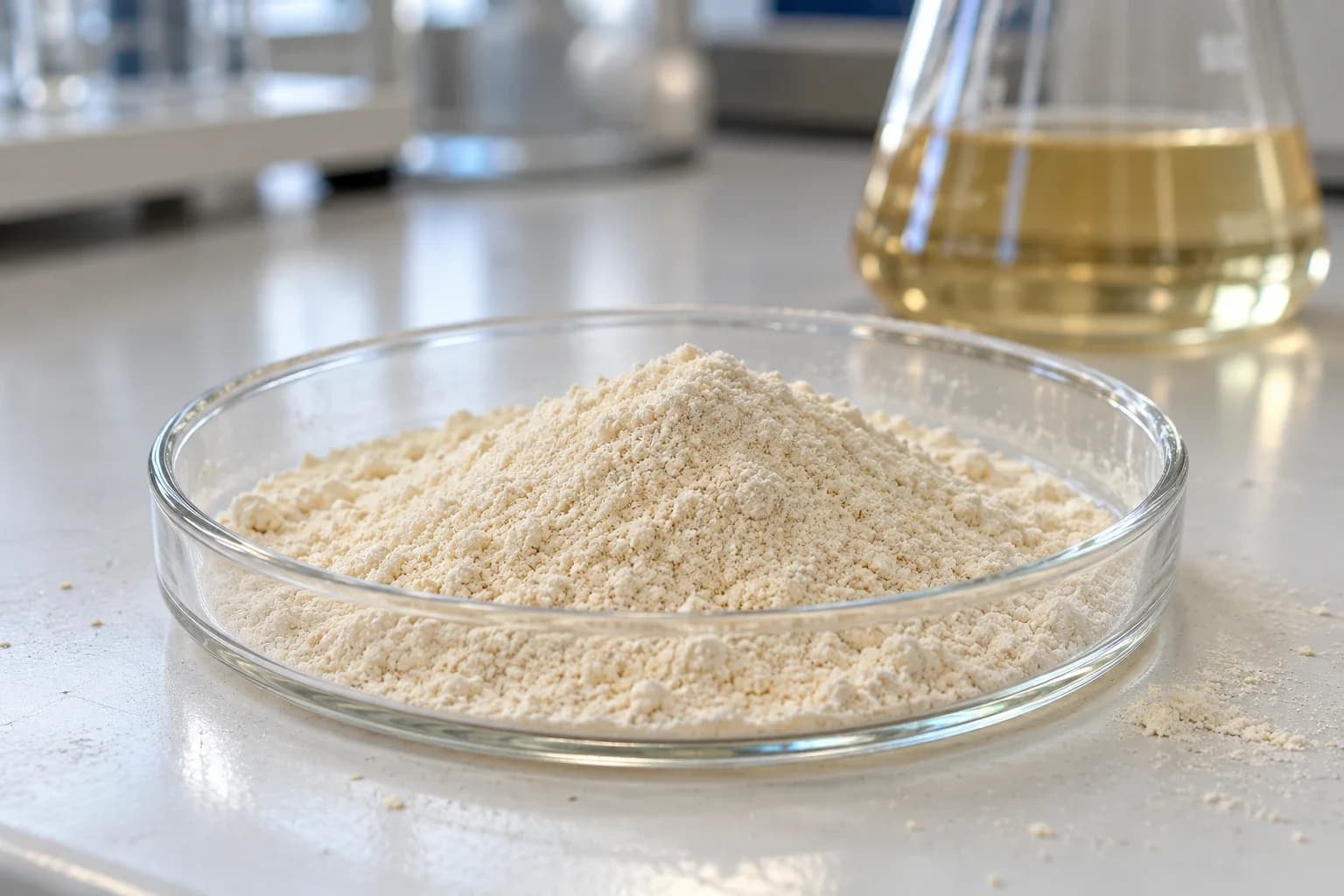
Antibiotic Medium 11
Also known as:Antibiotic Medium No. 11 (halal) · Antibiotic Assay Medium No. 11 (halal) · Neomycin Assay Agar (halal)
For the microbiological assay of antibiotics active at alkaline pH, such as neomycin and erythromycin, by the cylinder-plate method, in accordance with the United States Pharmacopeia.
- Category
- Dehydrated Culture Media
- Dissolve per litre
- 30.5 g
- Pack sizes
- 500 g · 5 kg · 25 kg
- Certifications
- ISO 22000 · Halal
Data updated:2026-11-06
Overview
Antibiotic Medium 11 is a broth (liquid) medium, one of the numbered pharmacopoeial media for antibiotic potency assays. It is specified by the pharmacopoeia for particular antibiotics and test organisms in potency assays; numbers are not interchangeable. STBIO manufactures it from food-grade raw materials in an ISO 22000 certified facility, with a COA for every batch. This is the Halal-certified version.
Principle
Antibiotic Medium 11 has the same composition as Antibiotic Medium 1 but is adjusted to an alkaline reaction, as specified by the United States Pharmacopeia for the cylinder-plate assay of certain antibiotics.¹ Peptone, pancreatic digest of casein, yeast extract, and beef extract supply nitrogen, amino acids, vitamins, and growth factors, and dextrose provides the carbon and energy source. The activity of aminoglycoside and macrolide antibiotics increases markedly at alkaline pH, and the elevated pH of this medium enhances their diffusion and inhibitory effect, producing larger and more clearly defined zones of inhibition. Antibiotic solutions diffuse from cylinders placed on the seeded agar, and the zone diameters are proportional to the antibiotic concentration. Uniform composition, pH, and agar depth are required for reproducible results.²
Antibiotic potency assay media
Antibiotic potency assays measure activity through the response of a test organism, and each antibiotic and assay method calls for a specific numbered medium taken from the pharmacopoeial formulations. Select the number specified by the pharmacopoeial chapter and method you follow; the media are not interchangeable.
Directions
Suspend 30.5 g of powder in 1 L of purified water. Heat with continuous stirring and bring to the boil for 1 minute. Sterilize by autoclaving at 121°C for 15 minutes. Cool to 45-50°C. Dispense into Petri plates or assay trays on a level surface to obtain a uniform depth, and inoculate the seed layer as specified in the assay procedure. Test the finished medium for performance using stable, standard control cultures.
Product highlights
- Food-grade raw materials, produced in an ISO 22000 certified facility
- Halal certified, suitable for the Malaysian, Indonesian, and Middle Eastern markets
- Manufactured to the standard formulation, 30.5 g per litre
- Available in 500 g / 5 kg / 25 kg, from laboratory to industrial scale
- COA, specification sheet, and technical data sheet available; samples on request
- Manufactured in Taiwan with reliable supply
Food grade versus laboratory grade
Most culture media suppliers use laboratory-grade raw materials, which are held to lower standards for heavy metal residues, microbial contamination control, and traceability. That is adequate for pure research but not for applications with stricter raw-material requirements. STBIO manufactures with food-grade raw materials throughout, in a facility certified to ISO 22000 food safety management.
- Food microbiology laboratories working to ISO 17025 or equivalent requirements
- Biotech manufacturers exporting fermentation products and needing full raw-material traceability
- Organisations with ESG or compliance audit requirements across their supply chain
- Companies sourcing both Halal and non-Halal products who need one consistent material grade
Frequently asked questions
01How much powder per litre?
Use 30.5 g per litre of deionised water; preparation and sterilisation conditions are given on the specification sheet.
02Which organisms is it suitable for?
Gram-positive. See the cultural response table and the specification sheet.
03Can it be used for food-grade applications?
Yes. It is made from food-grade raw materials in an ISO 22000 certified facility and is suitable for culturing starters for fermented products that are consumed directly.
04How is this product prepared?
Suspend 30.5 g of powder in 1 L of purified water. Heat with continuous stirring and bring to the boil for 1 minute. Sterilize by autoclaving at 121°C for 15 minutes. Cool to 45-50°C. Dispense into Petri plates or assay trays on a level surface to obtain a uniform depth, and inoculate the seed layer as specified in the assay procedure. Test the finished medium for performance using stable, standard control cultures.
05Is there a non-Halal version?
Yes. This is the Halal certified version; an equivalent standard version is also available.
06How do I request a bulk quotation, and can you provide a COA?
Yes. This product is available in 500 g, 5 kg, 25 kg. Tell us your application and volume when requesting a quotation; we reply within one working day and can supply the COA, specification sheet, and technical data sheet.
Used in these applications
References
- 1. United States Pharmacopeia, current edition. Chapter <81> Antibiotics — Microbial Assays, USP-NF, Rockville, MD.
- 2. Grove D. C. and Randall W. A., 1955. Assay Methods of Antibiotics: A Laboratory Manual, Medical Encyclopedia, New York.